Esther 5 KJV
Esther's Banquet
Esther's Banquet
Esther's decision to don royal apparel before approaching the throne deliberately invokes her queenly status under Persian protocol, transforming a potentially lethal breach of court etiquette into a calculated assertion of identity rather than mere supplication.
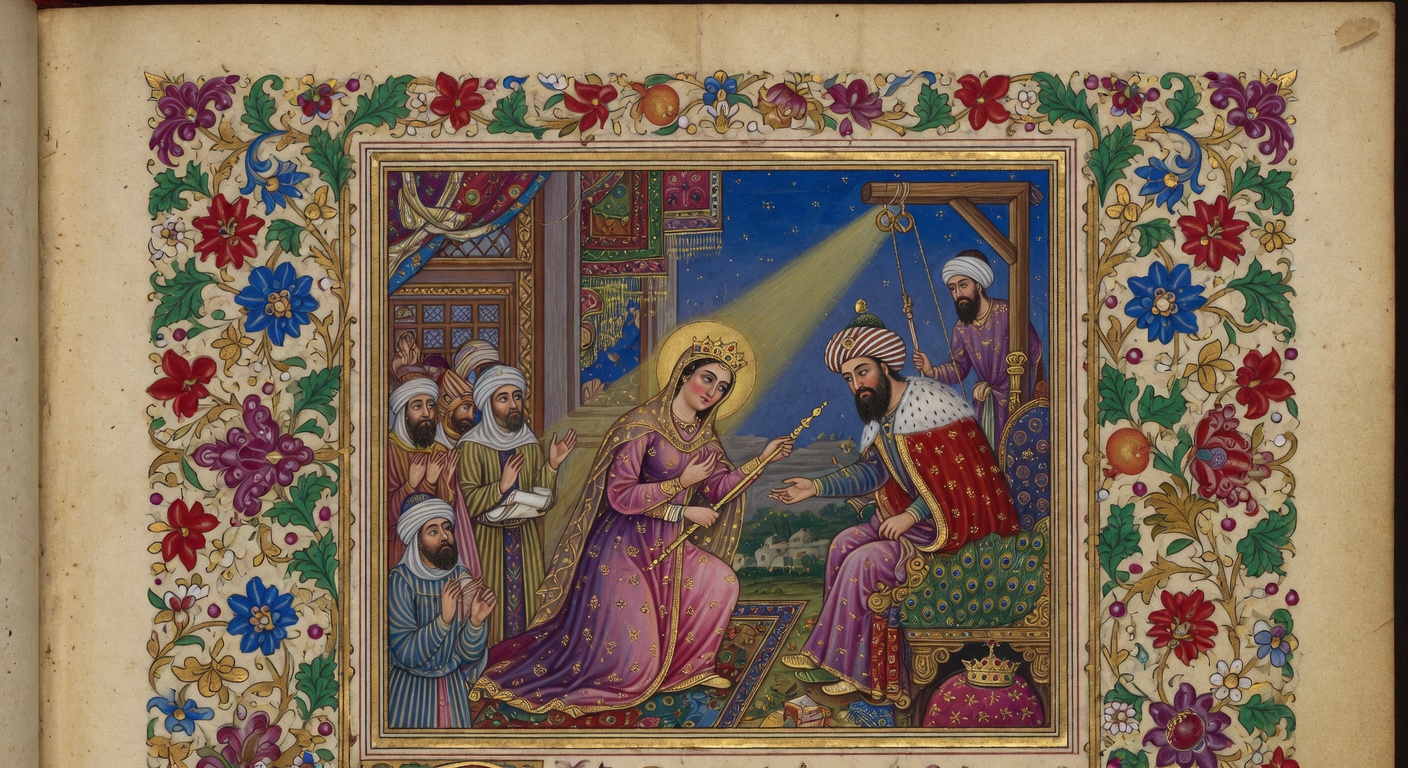
 1ow it came to pass on the third day, that Esther put on her royal apparel, and stood in the inner court of the king’s house, over against the king’s house: and the king sat upon his royal throne in the royal house, over against the gate of the house.
2 And it was so, when the king saw Esther the queen standing in the court, that she obtained favour in his sight: and the king held out to Esther the golden sceptre that was in his hand. So Esther drew near, and touched the top of the sceptre.
3 Then said the king unto her, What wilt thou, queen Esther? and what is thy request? it shall be even given thee to the half of the kingdom.
4 And Esther answered, If it seem good unto the king, let the king and Haman come this day unto the banquet that I have prepared for him.
5 Then the king said, Cause Haman to make haste, that he may do as Esther hath said. So the king and Haman came to the banquet that Esther had prepared.
6 And the king said unto Esther at the banquet of wine, What is thy petition? and it shall be granted thee: and what is thy request? even to the half of the kingdom it shall be performed.
7 Then answered Esther, and said, My petition and my request is;
8 If I have found favour in the sight of the king, and if it please the king to grant my petition, and to perform my request, let the king and Haman come to the banquet that I shall prepare for them, and I will do to morrow as the king hath said.
9 Then went Haman forth that day joyful and with a glad heart: but when Haman saw Mordecai in the king’s gate, that he stood not up, nor moved for him, he was full of indignation against Mordecai.
10 Nevertheless Haman refrained himself: and when he came home, he sent and called for his friends, and Zeresh his wife.
11 And Haman told them of the glory of his riches, and the multitude of his children, and all the things wherein the king had promoted him, and how he had advanced him above the princes and servants of the king.
12 Haman said moreover, Yea, Esther the queen did let no man come in with the king unto the banquet that she had prepared but myself; and to morrow am I invited unto her also with the king.
13 Yet all this availeth me nothing, so long as I see Mordecai the Jew sitting at the king’s gate.
14 Then said Zeresh his wife and all his friends unto him, Let a gallows be made of fifty cubits high, and to morrow speak thou unto the king that Mordecai may be hanged thereon: then go thou in merrily with the king unto the banquet. And the thing pleased Haman; and he caused the gallows to be made.
← → arrow keys to navigate chapters · spacebar to play/pause audio
Did You Know?
Esther's decision to don royal apparel before approaching the throne deliberately invokes her queenly status under Persian protocol, transforming a potentially lethal breach of court etiquette into a calculated assertion of identity rather than mere supplication.
The king's hyperbolic offer of 'even to the half of the kingdom' parallels Ahasuerus's earlier promise to Vashti, revealing a recurring rhetorical pattern that exposes the monarch's impulsive character while giving Esther precise leverage to time her petitions across two banquets.
Haman's private consultation with his wife and friends about erecting gallows specifically tailored for Mordecai imports domestic counsel into state policy, underscoring how personal vendettas in the Persian court could rapidly escalate into instruments of public execution.
The 50-cubit height of the gallows exceeds any functional necessity for a single hanging and functions as an ostentatious display of Haman's hubris, prefiguring the narrative's reversal where the same structure will publicly shame its builder.
Esther's call for a three-day communal fast before her unsummoned approach quietly mobilizes the Jewish diaspora in Susa without invoking God's name, embodying the book's theology of concealed providence where human initiative and hidden divine orchestration converge at the banquet.
Esther's original Hebrew name Hadassah appears only once in the text, identifying her as an orphan raised by her cousin Mordecai in the Persian citadel of Susa after the Babylonian exile.
Mordecai's name likely derives from the Babylonian god Marduk, illustrating how Jewish exiles in Persia often bore dual identities blending their heritage with local culture while preserving core religious practices.
Haman, identified as an Agagite, descends from the Amalekite royal line that Saul failed to eradicate centuries earlier, framing his genocidal plot as a continuation of the ancient Israelite-Amalekite conflict recorded in 1 Samuel.
Ahasuerus displayed his wealth and the splendor of his empire for 180 consecutive days to officials from 127 provinces stretching from India to Cush, an extravagant display recorded in Esther 1:4 that underscores the unprecedented scale of Persian courtly propaganda during the post-exilic era.
Through these accounts Persia reveals how the Lord sovereignly directs even mighty Gentile kingdoms to preserve his people and advance the promises of restoration.
Commentary & Study Notes Jamieson-Fausset-Brown (1871) · Public Domain Esther put on her royal apparel — It was not only natural, but, on such occasions, highly proper and expedient, that the queen should decorate herself in a style becoming her exalt…
Classic verse-by-verse commentary on Esther 5 from Jamieson, Fausset & Brown (1871). Covers: Esther invites the king and haman to a banquet.
- 1
- Esther put on her royal apparel — It was not only natural, but, on such occasions, highly proper and expedient, that the queen should decorate herself in a style becoming her exalted station. On ordinary occasions she might reasonably set off her charms to as much advantage as possible; but, on the present occasion, as she was desirous to secure the favor of one who sustained the twofold character of her husband and her sovereign, public as well as private considerations — a regard to her personal safety, no less than the preservation of her doomed countrymen — urged upon her the propriety of using every legitimate means of recommending herself to the favorable notice of Ahasuerus. the king sat upon his royal throne in the royal house, over against the gate of the house — The palace of this Persian king seems to have been built, like many more of the same quality and description, with an advanced cloister, over against the gate, made in the fashion of a large penthouse, supported only by one or two contiguous pillars in the front, or else in the center. In such open structures as these, in the midst of their guards and counsellors, are the bashaws, kadis, and other great officers, accustomed to distribute justice, and transact the public affairs of the provinces [SHAW, Travels]. In such a situation the Persian king was seated. The seat he occupied was not a throne, according to our ideas of one, but simply a chair, and so high that it required a footstool. It was made of gold, or, at least, inlaid with that metal, and covered with splendid tapestry, and no one save the king might sit down on it under pain of death. It is often found pictured on the Persepolitan monuments, and always of the same fashion.
- 2
- the king held out to Esther the golden sceptre that was in his hand — This golden scepter receives an interesting illustration from the sculptured monuments of Persia and Assyria. In the bas-reliefs of Persepolis, copied by Sir Robert Ker Porter, we see King Darius enthroned in the midst of his court, and walking abroad in equal state; in either case he carries in his right hand a slender rod or wand, about equal in length to his own height, ornamented with a small knob at the summit. In the Assyrian alabasters, those found at Nimroud as well as those from Khorsabad, "the great king" is furnished with the same appendage of royalty, a slender rod, but destitute of any knob or ornament. On the Khorsabad reliefs the rod is painted red, doubtless to represent gold; proving that "the golden sceptre" was a simple wand of that precious metal, commonly held in the right hand, with one end resting on the ground, and that whether the king was sitting or walking. "The gold sceptre" has received little alteration or modification since ancient times [GOSS]. It was extended to Esther as a token not only that her intrusion was pardoned, but that her visit was welcome, and a favorable reception given to the suit she had come to prefer. touched the top of the sceptre — This was the usual way of acknowledging the royal condescension, and at the same time expressing reverence and submission to the august majesty of the king.
Read all 5 notes on Esther 5 →