Hebrews 6 KJV
Warning Against Falling Away
Warning Against Falling Away
The list of five spiritual privileges in verses 4-5 employs repeated sensory verbs like 'tasted' to portray apostasy not as mere intellectual rejection but as a visceral betrayal of intimate divine encounter, echoing Exodus wilderness experiences where tasting manna led to rebellion. Themes: Hope
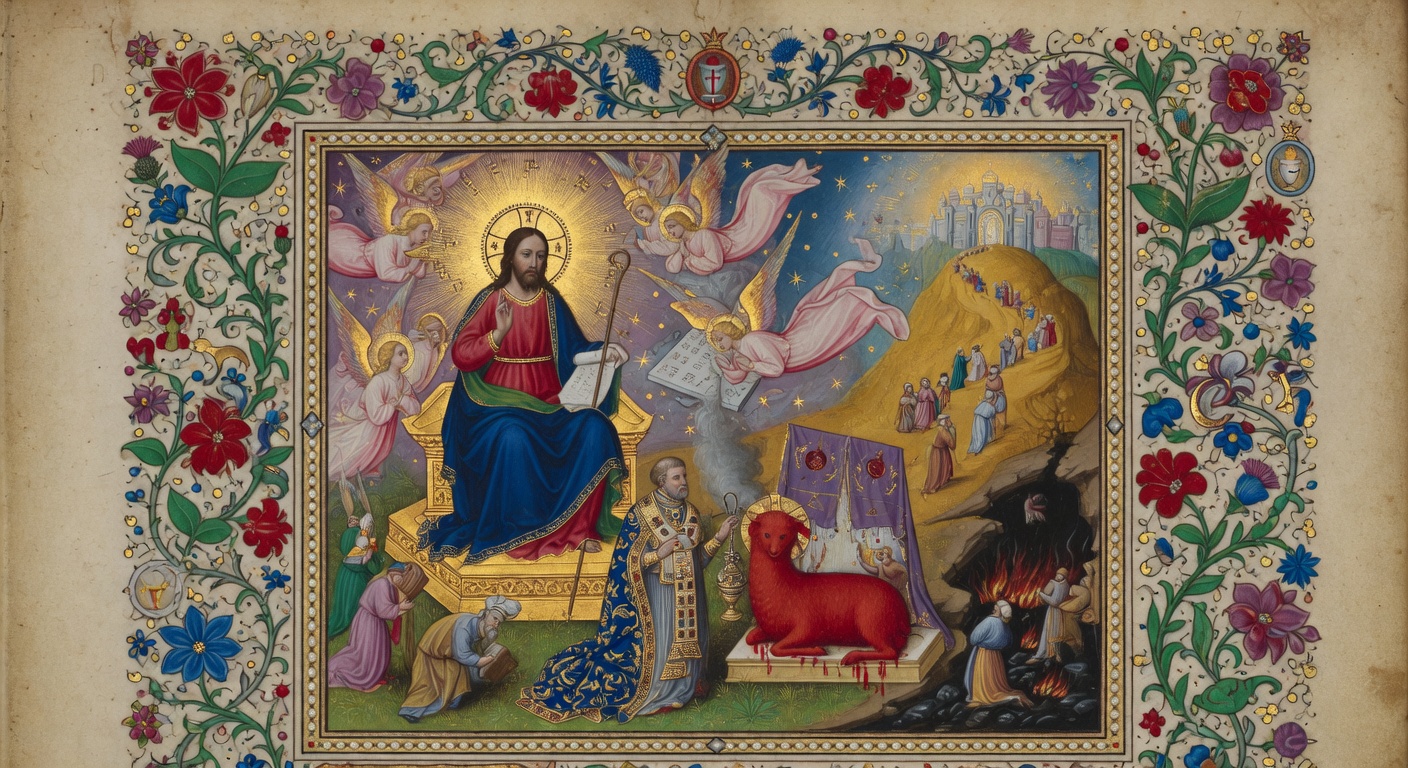
 1herefore leaving the principles of the doctrine of Christ, let us go on unto perfection; not laying again the foundation of repentance from dead works, and of faith toward God,
2 Of the doctrine of baptisms, and of laying on of hands, and of resurrection of the dead, and of eternal judgment.
3 And this will we do, if God permit.
4 For it is impossible for those who were once enlightened, and have tasted of the heavenly gift, and were made partakers of the Holy Ghost,
5 And have tasted the good word of God, and the powers of the world to come,
6 If they shall fall away, to renew them again unto repentance; seeing they crucify to themselves the Son of God afresh, and put him to an open shame.
7 For the earth which drinketh in the rain that cometh oft upon it, and bringeth forth herbs meet for them by whom it is dressed, receiveth blessing from God:
8 But that which beareth thorns and briers is rejected, and is nigh unto cursing; whose end is to be burned.
9 But, beloved, we are persuaded better things of you, and things that accompany salvation, though we thus speak.
10 For God is not unrighteous to forget your work and labour of love, which ye have shewed toward his name, in that ye have ministered to the saints, and do minister.
11 And we desire that every one of you do shew the same diligence to the full assurance of hope unto the end:
12 That ye be not slothful, but followers of them who through faith and patience inherit the promises.
13 For when God made promise to Abraham, because he could swear by no greater, he sware by himself,
14 Saying, Surely blessing I will bless thee, and multiplying I will multiply thee.
15 And so, after he had patiently endured, he obtained the promise.
16 For men verily swear by the greater: and an oath for confirmation is to them an end of all strife.
17 Wherein God, willing more abundantly to shew unto the heirs of promise the immutability of his counsel, confirmed it by an oath:
18 That by two immutable things, in which it was impossible for God to lie, we might have a strong consolation, who have fled for refuge to lay hold upon the hope set before us:
19 Which hope we have as an anchor of the soul, both sure and stedfast, and which entereth into that within the veil;
20 Whither the forerunner is for us entered, even Jesus, made an high priest for ever after the order of Melchisedec.
← → arrow keys to navigate chapters · spacebar to play/pause audio
Did You Know?
The list of five spiritual privileges in verses 4-5 employs repeated sensory verbs like 'tasted' to portray apostasy not as mere intellectual rejection but as a visceral betrayal of intimate divine encounter, echoing Exodus wilderness experiences where tasting manna led to rebellion.
Verse 6's 'crucify the Son of God afresh' draws on Roman execution practices familiar to the audience, framing apostasy as a public, shameful spectacle that re-inflicts the cross rather than a private lapse, heightening the warning's rhetorical force.
The agricultural parable in verses 7-8 mirrors Deuteronomy 29's covenant curses on fruitful versus thorny land, transforming an Old Testament land motif into a New Testament warning that apostate believers risk becoming covenantally cursed ground.
God's self-oath in verses 13-18 invokes ancient Near Eastern legal customs where swearing by oneself was the ultimate guarantee when no higher authority existed, underscoring that divine promises rest on God's own immutable nature rather than external enforcement.
The 'forerunner' (prodromos) in verse 20 employs a Greek military term for an advance scout who secures a beachhead, portraying Christ's entry behind the veil as establishing a secured path for believers rather than a solitary priestly act.
Jesus paid the annual temple tax by instructing Peter to catch a fish whose mouth contained the exact coin needed, a detail unique to Matthew 17 that blends miracle with practical provision in first-century Jewish life.
He is the first person in Scripture explicitly titled both king and priest of El Elyon, the Most High God, appearing without genealogy or prior introduction in Genesis 14 to bless Abraham and receive a tenth of the spoils.
Abraham led a military raid with only 318 trained servants from his household to defeat a coalition of four Mesopotamian kings and rescue his nephew Lot, as recorded in Genesis 14.
Moses initially resisted his divine commission at the burning bush by citing a speech impediment, prompting God to designate Aaron as his official spokesman while Moses retained ultimate authority in conveying messages to Pharaoh.
This location became the focal point of national worship and divine promises, later extending symbolically to encompass the Temple Mount where Solomon built the house of the Lord.
Commentary & Study Notes Jamieson-Fausset-Brown (1871) · Public Domain Therefore — Wherefore: seeing that ye ought not now to be still "babes" (Heb 5:11-14). leaving — getting further forward than the elementary "principles." "As in building a house o…
Classic verse-by-verse commentary on Hebrews 6 from Jamieson, Fausset & Brown (1871). Covers: Warning against retrograding, which soon leads to apostasy; Encouragement to steadfastness from God's faithfulness to his word and oath.
- 1
- Therefore — Wherefore: seeing that ye ought not now to be still "babes" (Heb 5:11-14). leaving — getting further forward than the elementary "principles." "As in building a house one must never leave the foundation: yet to be always laboring in 'laying the foundation' would be ridiculous" [CALVIN]. the principles of the doctrine — Greek, "the word of the beginning," that is, the discussion of the "first principles of Christianity (Heb 5:12). let us go on — Greek, "let us be borne forward," or "bear ourselves forward"; implying active exertion: press on. Paul, in teaching, here classifies himself with the Hebrew readers, or (as they ought to be) learners, and says, Let us together press forward. perfection — the matured knowledge of those who are "of full age" (Heb 5:14) in Christian attainments. foundation of — that is, consisting in "repentance." repentance from dead works — namely, not springing from the vital principle of faith and love toward God, and so counted, like their doer, dead before God. This repentance from dead works is therefore paired with "faith toward God." The three pairs of truths enumerated are designedly such as JEWISH believers might in some degree have known from the Old Testament, but had been taught more clearly when they became Christians. This accounts for the omission of distinct specification of some essential first principle of Christian truth. Hence, too, he mentions "faith toward God," and not explicitly faith toward Christ (though of course included). Repentance and faith were the first principles taught under the Gospel.
- 2
- the doctrine of baptisms — paired with "laying on of hands," as the latter followed on Christian baptism, and answers to the rite of confirmation in Episcopal churches. Jewish believers passed, by an easy transition, from Jewish baptismal purifications (Heb 9:10, "washings"), baptism of proselytes, and John's baptism, and legal imposition of hands, to their Christian analogues, baptism, and the subsequent laying on of hands, accompanied by the gift of the Holy Ghost (compare Heb 6:4). Greek, "baptismoi," plural, including Jewish and Christian baptisms, are to be distinguished from baptisma, singular, restricted to Christian baptism. The six particulars here specified had been, as it were, the Christian Catechism of the Old Testament; and such Jews who had begun to recognize Jesus as the Christ immediately on the new light being shed on these fundamental particulars, were accounted as having the elementary principles of the doctrine of Christ [BENGEL]. The first and most obvious elementary instruction of Jews would be the teaching them the typical significance of their own ceremonial law in its Christian fulfilment [ALFORD]. resurrection, &c. — held already by the Jews from the Old Testament: confirmed with clearer light in Christian teaching or "doctrine." eternal judgment — judgment fraught with eternal consequences either of joy or of woe.
Read all 20 notes on Hebrews 6 →