Isaiah 28 KJV
Woe to Ephraim
Echoes & Connections 1 connections
Woe to Ephraim
The chapter's agricultural parable (vv. 23-29) uniquely depicts God as a discerning farmer who tailors plowing, sowing, and threshing methods to each crop, illustrating that divine judgment and revelation operate with precise, context-specific wisdom rather than uniform force.
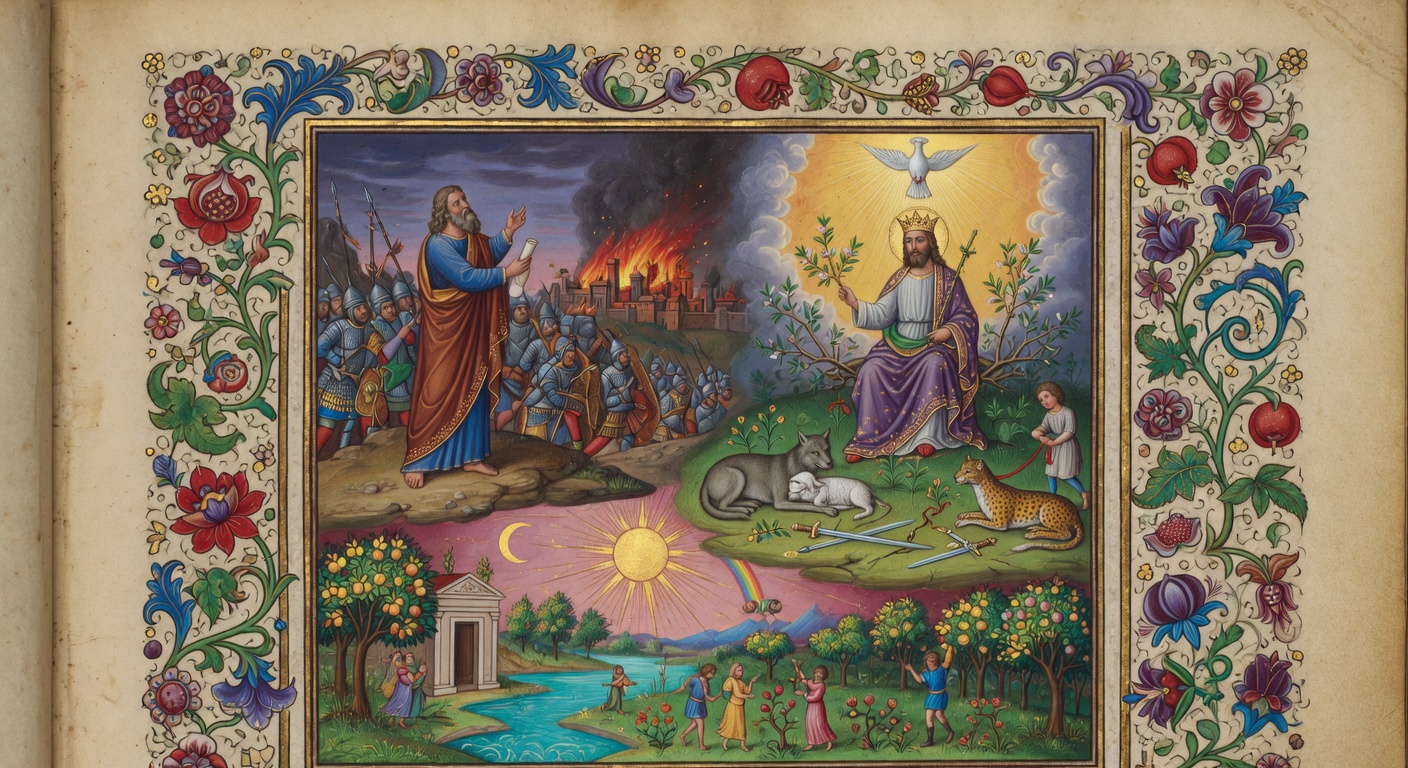
 1oe to the crown of pride, to the drunkards of Ephraim, whose glorious beauty is a fading flower, which are on the head of the fat valleys of them that are overcome with wine!
2 Behold, the Lord hath a mighty and strong one, which as a tempest of hail and a destroying storm, as a flood of mighty waters overflowing, shall cast down to the earth with the hand.
3 The crown of pride, the drunkards of Ephraim, shall be trodden under feet:
4 And the glorious beauty, which is on the head of the fat valley, shall be a fading flower, and as the hasty fruit before the summer; which when he that looketh upon it seeth, while it is yet in his hand he eateth it up.
5 In that day shall the LORD of hosts be for a crown of glory, and for a diadem of beauty, unto the residue of his people,
6 And for a spirit of judgment to him that sitteth in judgment, and for strength to them that turn the battle to the gate.
7 But they also have erred through wine, and through strong drink are out of the way; the priest and the prophet have erred through strong drink, they are swallowed up of wine, they are out of the way through strong drink; they err in vision, they stumble in judgment.
8 For all tables are full of vomit and filthiness, so that there is no place clean.
9 Whom shall he teach knowledge? and whom shall he make to understand doctrine? them that are weaned from the milk, and drawn from the breasts.
10 For precept must be upon precept, precept upon precept; line upon line, line upon line; here a little, and there a little:
11 For with stammering lips and another tongue will he speak to this people.
12 To whom he said, This is the rest wherewith ye may cause the weary to rest; and this is the refreshing: yet they would not hear.
13 But the word of the LORD was unto them precept upon precept, precept upon precept; line upon line, line upon line; here a little, and there a little; that they might go, and fall backward, and be broken, and snared, and taken.
14 Wherefore hear the word of the LORD, ye scornful men, that rule this people which is in Jerusalem.
15 Because ye have said, We have made a covenant with death, and with hell are we at agreement; when the overflowing scourge shall pass through, it shall not come unto us: for we have made lies our refuge, and under falsehood have we hid ourselves:
16 Therefore thus saith the Lord GOD, Behold, I lay in Zion for a foundation a stone, a tried stone, a precious corner stone, a sure foundation: he that believeth shall not make haste.
17 Judgment also will I lay to the line, and righteousness to the plummet: and the hail shall sweep away the refuge of lies, and the waters shall overflow the hiding place.
18 And your covenant with death shall be disannulled, and your agreement with hell shall not stand; when the overflowing scourge shall pass through, then ye shall be trodden down by it.
19 From the time that it goeth forth it shall take you: for morning by morning shall it pass over, by day and by night: and it shall be a vexation only to understand the report.
20 For the bed is shorter than that a man can stretch himself on it: and the covering narrower than that he can wrap himself in it.
21 For the LORD shall rise up as in mount Perazim, he shall be wroth as in the valley of Gibeon, that he may do his work, his strange work; and bring to pass his act, his strange act.
22 Now therefore be ye not mockers, lest your bands be made strong: for I have heard from the Lord GOD of hosts a consumption, even determined upon the whole earth.
23 Give ye ear, and hear my voice; hearken, and hear my speech.
24 Doth the plowman plow all day to sow? doth he open and break the clods of his ground?
25 When he hath made plain the face thereof, doth he not cast abroad the fitches, and scatter the cummin, and cast in the principal wheat and the appointed barley and the rie in their place?
26 For his God doth instruct him to discretion, and doth teach him.
27 For the fitches are not threshed with a threshing instrument, neither is a cart wheel turned about upon the cummin; but the fitches are beaten out with a staff, and the cummin with a rod.
28 Bread corn is bruised; because he will not ever be threshing it, nor break it with the wheel of his cart, nor bruise it with his horsemen.
29 This also cometh forth from the LORD of hosts, which is wonderful in counsel, and excellent in working.
← → arrow keys to navigate chapters · spacebar to play/pause audio
Did You Know?
The chapter's agricultural parable (vv. 23-29) uniquely depicts God as a discerning farmer who tailors plowing, sowing, and threshing methods to each crop, illustrating that divine judgment and revelation operate with precise, context-specific wisdom rather than uniform force.
Isaiah's reference to a 'covenant with death' (vv. 15,18) likely evokes ancient Near Eastern necromantic rituals or alliances invoking underworld deities, revealing how Judah's leaders sought security through forbidden spiritual pacts amid Assyrian threats.
The 'precept upon precept' mockery (vv. 10,13) renders Hebrew monosyllables (tsav latsav, qav laqav) that phonetically mimic both childish babbling and the repetitive hammering of a builder's line, underscoring the leaders' contempt for Isaiah's message as simplistic while ironically sealing their doom through the same words.
Verse 16's cornerstone laid in Zion, described as tested and sure, functions as a messianic pivot within Isaiah's oracles against the nations, later explicitly applied in the New Testament to Christ while echoing ancient temple foundation rituals that symbolized cosmic stability.
The 'overflowing scourge' imagery (vv. 15,18) merges Assyrian military invasion with primordial flood motifs from Genesis, portraying judgment as both historical conquest and a return to chaotic waters that only true refuge in God's word can withstand.
The Dead Sea Scroll 1QIsa^a, copied around 125 BC, contains the entire book of Isaiah with only minor variants from the later Masoretic Text, providing the oldest complete witness to any biblical book and demonstrating extraordinary textual stability.
Hezekiah dispatched couriers throughout the former northern kingdom to summon survivors to an unprecedented Passover in Jerusalem, resulting in such a large attendance that the Levites had to assist with sacrifices because many participants had not properly consecrated themselves.
Jesus appeared to over five hundred people at one time after his resurrection, a mass sighting noted by Paul in 1 Corinthians 15 that provides early corroboration beyond the Gospel accounts.
Jerusalem is mentioned over 800 times in the Bible. More than any other city.
Babylon's walls were reportedly wide enough for two chariots to pass side by side.
In this way, Assyria plays a pivotal role in the unfolding redemptive narrative, illustrating both the severity of divine judgment and the breadth of divine compassion.