Jeremiah 47 KJV
Oracle Against the Philistines
Oracle Against the Philistines
The superscription tying the oracle to Pharaoh Necho’s smiting of Gaza supplies a precise synchronism with Egyptian incursions of 609-605 BCE that is otherwise unattested in biblical or extra-biblical sources.
 1he word of the LORD that came to Jeremiah the prophet against the Philistines, before that Pharaoh smote Gaza.
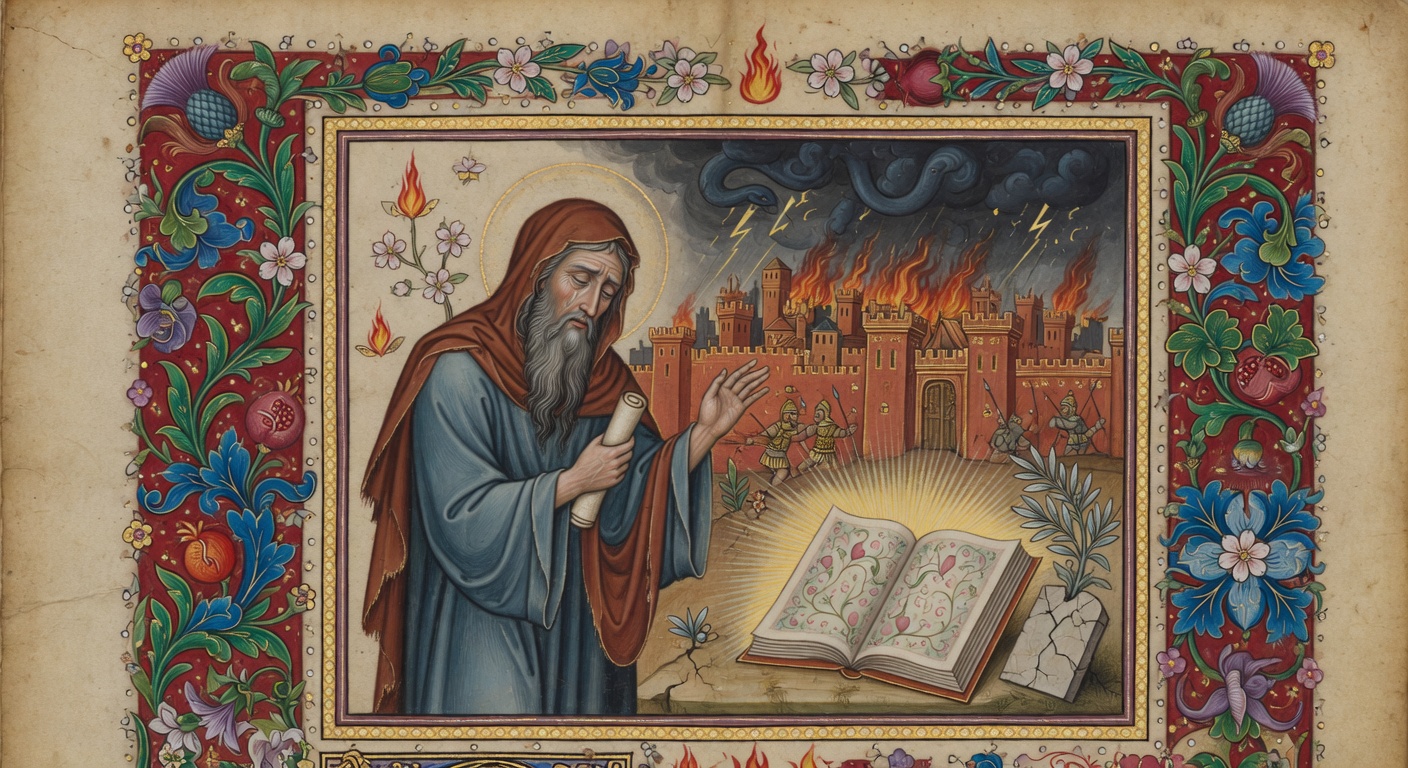
2 Thus saith the LORD; Behold, waters rise up out of the north, and shall be an overflowing flood, and shall overflow the land, and all that is therein; the city, and them that dwell therein: then the men shall cry, and all the inhabitants of the land shall howl.
3 At the noise of the stamping of the hoofs of his strong horses, at the rushing of his chariots, and at the rumbling of his wheels, the fathers shall not look back to their children for feebleness of hands;
4 Because of the day that cometh to spoil all the Philistines, and to cut off from Tyrus and Zidon every helper that remaineth: for the LORD will spoil the Philistines, the remnant of the country of Caphtor.
5 Baldness is come upon Gaza; Ashkelon is cut off with the remnant of their valley: how long wilt thou cut thyself?
6 O thou sword of the LORD, how long will it be ere thou be quiet? put up thyself into thy scabbard, rest, and be still.
7 How can it be quiet, seeing the LORD hath given it a charge against Ashkelon, and against the sea shore? there hath he appointed it.
← → arrow keys to navigate chapters · spacebar to play/pause audio
Did You Know?
The superscription tying the oracle to Pharaoh Necho’s smiting of Gaza supplies a precise synchronism with Egyptian incursions of 609-605 BCE that is otherwise unattested in biblical or extra-biblical sources.
Verse 4’s explicit linkage of the Philistines to Caphtor (Crete/Aegean) echoes the migration traditions of Amos 9:7 and Deuteronomy 2:23, underscoring that YHWH’s judgment reaches even to the ancestral homeland of Israel’s ancient coastal foes.
The rhetorical address to “the sword of the LORD” in verse 6, urging it to rest, momentarily personifies divine wrath and reveals the prophet’s dramatic, almost intercessory stance within an otherwise unrelenting judgment oracle.
The “waters rising out of the north” in verse 2 adapt the primeval flood motif (Genesis 7, Isaiah 8) to military hydrology, evoking the seasonal inundations and chariot tactics of Babylonian campaigns along the coastal plain.
By naming Tyre and Sidon as “helpers that remain” to be cut off (v. 4), the chapter widens the scope from Philistia alone to the entire Levantine seaboard, anticipating Nebuchadnezzar’s systematic reduction of every maritime power that might aid Egypt.
King Jehoiakim personally cut and burned Jeremiah’s scroll of prophecies column by column in his winter palace fireplace, prompting the prophet to dictate an expanded second edition that included a specific curse against the king.
After King Jehoiakim burned the first scroll of Jeremiah's prophecies in 604 BC, Baruch produced a second edition that added many similar words, demonstrating the fluid expansion of prophetic literature during the late monarchy.
The Babylonian Chronicles corroborate the biblical account of Nebuchadnezzar's 597 BC siege of Jerusalem, during which he deported King Jehoiachin and installed Zedekiah, marking the first major wave of exile.
Gedaliah set up his administration at Mizpah rather than the ruined Jerusalem, where he urged the surviving Judeans to submit to Babylonian rule and resume agricultural life, briefly restoring a measure of normalcy in 586 BCE.
Three major world religions consider Jerusalem a holy city.
The city fell to Persia in 539 BC exactly as Daniel prophesied. Conquered without a battle.
The Nile River was worshipped as a god. Making the plague of blood a direct challenge to Egyptian religion.
Commentary & Study Notes Jamieson-Fausset-Brown (1871) · Public Domain Pharaoh-necho probably smote Gaza on his return after defeating Josiah at Megiddo (2Ch 35:20) [GROTIUS]. Or, Pharaoh-hophra (Jer 37:5, 7) is intended: probably on his return from h…
Classic verse-by-verse commentary on Jeremiah 47 from Jamieson, Fausset & Brown (1871). Covers: Prophecy against the philistines.
- 1
- Pharaoh-necho probably smote Gaza on his return after defeating Josiah at Megiddo (2Ch 35:20) [GROTIUS]. Or, Pharaoh-hophra (Jer 37:5, 7) is intended: probably on his return from his fruitless attempt to save Jerusalem from the Chaldeans, he smote Gaza in order that his expedition might not be thought altogether in vain [CALVIN] (Am 1:6, 7).
- 2
- waters — (Isa 8:7). The Chaldeans from the north are compared to the overwhelming waters of their own Euphrates. The smiting of Gaza was to be only the prelude of a greater disaster to the Philistines. Nebuzara-dan was left by Nebuchadnezzar, after he had taken Jerusalem, to subdue the rest of the adjoining cities and country.
Read all 7 notes on Jeremiah 47 →