Malachi 3 KJV
The Coming Messenger
Echoes & Connections 2 connections
The Coming Messenger
Malachi 3:1 merges the preparatory messenger with the sudden arrival of the Lord himself at the temple, creating an ambiguous figure that New Testament writers later split between John the Baptist and Christ while preserving the original's covenantal tension.
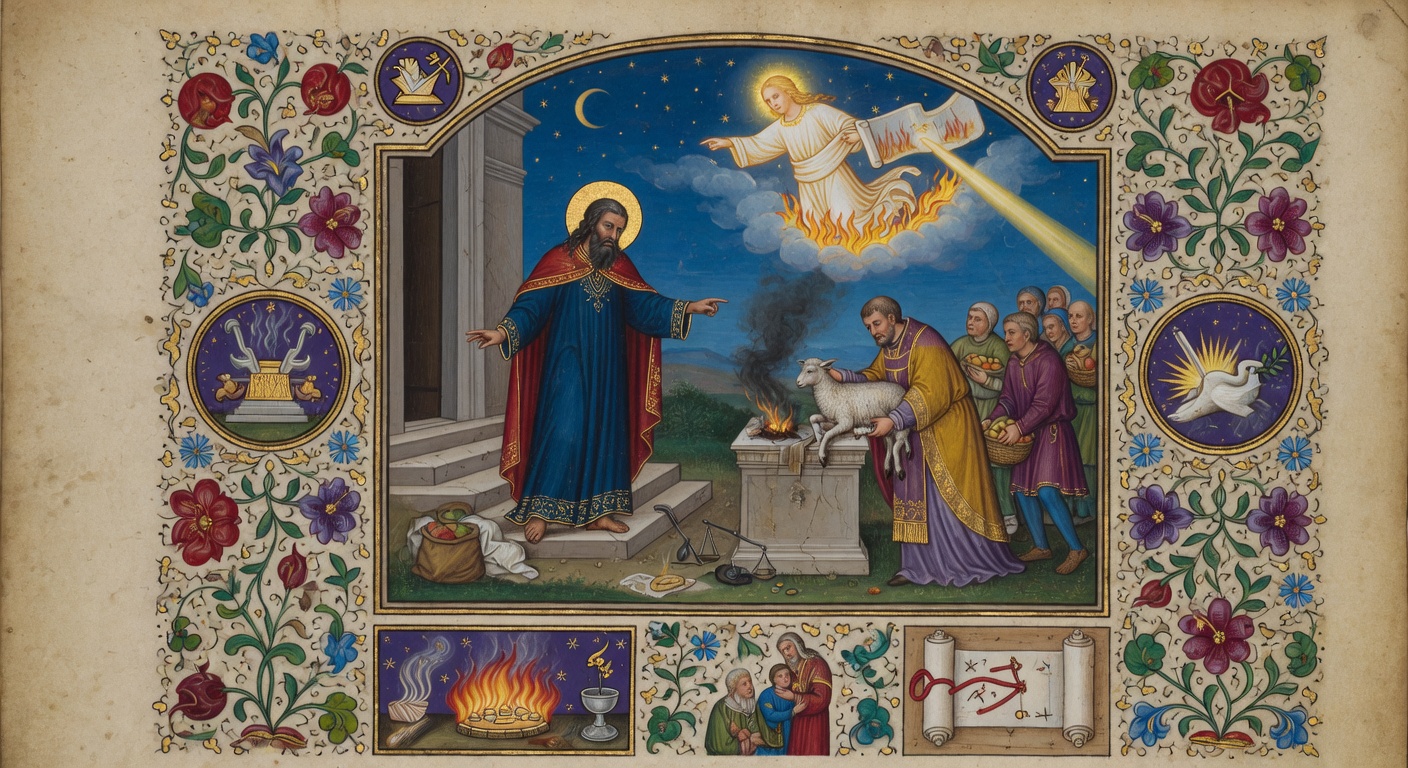
 1ehold, I will send my messenger, and he shall prepare the way before me: and the LORD, whom ye seek, shall suddenly come to his temple, even the messenger of the covenant, whom ye delight in: behold, he shall come, saith the LORD of hosts.
2 But who may abide the day of his coming? and who shall stand when he appeareth? for he is like a refiner’s fire, and like fullers’ soap:
3 And he shall sit as a refiner and purifier of silver: and he shall purify the sons of Levi, and purge them as gold and silver, that they may offer unto the LORD an offering in righteousness.
4 Then shall the offering of Judah and Jerusalem be pleasant unto the LORD, as in the days of old, and as in former years.
5 And I will come near to you to judgment; and I will be a swift witness against the sorcerers, and against the adulterers, and against false swearers, and against those that oppress the hireling in his wages, the widow, and the fatherless, and that turn aside the stranger from his right, and fear not me, saith the LORD of hosts.
6 For I am the LORD, I change not; therefore ye sons of Jacob are not consumed.
7 Even from the days of your fathers ye are gone away from mine ordinances, and have not kept them. Return unto me, and I will return unto you, saith the LORD of hosts. But ye said, Wherein shall we return?
8 Will a man rob God? Yet ye have robbed me. But ye say, Wherein have we robbed thee? In tithes and offerings.
9 Ye are cursed with a curse: for ye have robbed me, even this whole nation.
10 Bring ye all the tithes into the storehouse, that there may be meat in mine house, and prove me now herewith, saith the LORD of hosts, if I will not open you the windows of heaven, and pour you out a blessing, that there shall not be room enough to receive it.
11 And I will rebuke the devourer for your sakes, and he shall not destroy the fruits of your ground; neither shall your vine cast her fruit before the time in the field, saith the LORD of hosts.
12 And all nations shall call you blessed: for ye shall be a delightsome land, saith the LORD of hosts.
13 Your words have been stout against me, saith the LORD. Yet ye say, What have we spoken so much against thee?
14 Ye have said, It is vain to serve God: and what profit is it that we have kept his ordinance, and that we have walked mournfully before the LORD of hosts?
15 And now we call the proud happy; yea, they that work wickedness are set up; yea, they that tempt God are even delivered.
16 Then they that feared the LORD spake often one to another: and the LORD hearkened, and heard it, and a book of remembrance was written before him for them that feared the LORD, and that thought upon his name.
17 And they shall be mine, saith the LORD of hosts, in that day when I make up my jewels; and I will spare them, as a man spareth his own son that serveth him.
18 Then shall ye return, and discern between the righteous and the wicked, between him that serveth God and him that serveth him not.
← → arrow keys to navigate chapters · spacebar to play/pause audio
Did You Know?
Malachi 3:1 merges the preparatory messenger with the sudden arrival of the Lord himself at the temple, creating an ambiguous figure that New Testament writers later split between John the Baptist and Christ while preserving the original's covenantal tension.
The refiner's fire and fuller's soap in verse 2 invoke ancient metallurgical and textile processes that demand the removal of impurities through heat and alkali, portraying divine judgment as an active, transformative ordeal rather than passive punishment.
Verse 6's assertion 'I am the LORD, I change not' functions as the direct rationale for sparing Jacob's descendants, anchoring the chapter's message of continuity in God's character amid post-exilic disillusionment.
The 'windows of heaven' opened for tithing in verse 10 deliberately echoes the Genesis floodgates, reversing destructive waters into agricultural blessing and linking faithful giving to cosmic reversal of curse.
Inclusion of 'those that oppress the hireling in his wages' alongside sorcerers and adulterers in verse 5 reveals that the prophet equates economic exploitation with ritual impurity, reflecting the social fractures of the restored temple community.
Malachi 4:2 promises that the "sun of righteousness" will rise with healing in its wings, a metaphor drawing from ancient Near Eastern imagery of winged solar deities but applied uniquely to Yahweh's coming justice.
John's execution by beheading was prompted by a dance performed by Herodias's daughter at Herod's birthday banquet, leading to a rash oath that the king felt compelled to honor (Mark 6:21-28).
Three major world religions consider Jerusalem a holy city.
Edom was the nation descended from Esau, the brother of Jacob, and was located southeast of the Dead Sea in the rugged hill country of Seir.
Commentary & Study Notes Jamieson-Fausset-Brown (1871) · Public Domain Behold — Calling especial attention to the momentous truths which follow. Ye unbelievingly ask, Where is the God of judgment (Mal 2:7)? "Behold," therefore, "I send," &c. Your…
Classic verse-by-verse commentary on Malachi 3 from Jamieson, Fausset & Brown (1871). Covers: Messiah's coming, preceded by his forerunner, to punish the guilty for various sins, and to reward those who fear God.
- 1
- Behold — Calling especial attention to the momentous truths which follow. Ye unbelievingly ask, Where is the God of judgment (Mal 2:7)? "Behold," therefore, "I send," &c. Your unbelief will not prevent My keeping My covenant, and bringing to pass in due time that which ye say will never be fulfilled. I will send... he shall come — The Father sends the Son: the Son comes. Proving the distinctness of personality between the Father and the Son. my messenger — John the Baptist; as Mt 3:3; 11:10; Mr 1:2, 3; Lu 1:76; 3:4; 7:26, 27; Joh 1:23, prove. This passage of Malachi evidently rests on that of Isaiah his predecessor (Isa 40:3-5). Perhaps also, as HENGSTENBERG thinks, "messenger" includes the long line of prophets headed by Elijah (whence his name is put in Mal 4:5 as a representative name), and terminating in John, the last and greatest of the prophets (Mt 11:9-11). John as the representative prophet (the forerunner of Messiah the representative God-man) gathered in himself all the scattered lineaments of previous prophecy (hence Christ terms him "much more than a prophet," Lu 7:26), reproducing all its awful and yet inspiriting utterances: his coarse garb, like that of the old prophets, being a visible exhortation to repentance; the wilderness in which he preached symbolizing the lifeless, barren state of the Jews at that time, politically and spiritually; his topics sin, repentance, and salvation, presenting for the last time the condensed epitome of all previous teachings of God by His prophets; so that he is called pre-eminently God's "messenger." Hence the oldest and true reading of Mr 1:2 is, "as it is written in Isaiah the prophet"; the difficulty of which is, How can the prophecy of Malachi be referred to Isaiah? The explanation is: the passage in Malachi rests on that in Isa 40:3, and therefore the original source of the prophecy is referred to in order to mark this dependency and connection. the Lord — Ha-Adon in Hebrew. The article marks that it is JEHOVAH (Ex 23:17; 34:23; compare Jos 3:11, 13). Compare Da 9:17, where the Divine Son is meant by "for THE Lord's sake." God the speaker makes "the Lord," the "messenger of the covenant," one with Himself. "I will send... before Me," adding, "THE LORD... shall... come"; so that "the Lord" must be one with the "Me," that is, He must be GOD, "before" whom John was sent. As the divinity of the Son and His oneness with the Father are thus proved, so the distinctness of personality is proved by "I send" and He "shall come," as distinguished from one another. He also comes to the temple as "His temple": marking His divine lordship over it, as contrasted with all creatures, who are but "servants in" it (Hag 2:7; Heb 3:2, 5, 6). whom ye seek... whom ye delight in — (see on Mal 2:17). At His first coming they "sought" and "delighted in" the hope of a temporal Saviour: not in what He then was. In the case of those whom Malachi in his time addresses, "whom ye seek... delight in," is ironical. They unbelievingly asked, When will He come at last? Mal 2:17, "Where is the God of judgment" (Isa 5:19; Am 5:18; 2Pe 3:3, 4)? In the case of the godly, the desire for Messiah was sincere (Lu 2:25, 28). He is called "Angel of God's presence" (Isa 63:9), also Angel of Jehovah. Compare His appearances to Abraham (Ge 18:1, 2, 17, 33), to Jacob (Ge 31:11; 48:15, 16), to Moses in the bush (Ex 3:2-6); He went before Israel as the Shekinah (Ex 14:19), and delivered the law at Sinai (Ac 7:38). suddenly — This epithet marks the second coming, rather than the first; the earnest of that unexpected coming (Lu 12:38-46; Re 16:15) to judgment was given in the judicial expulsion of the money-changing profaners from the temple by Messiah (Mt 21:12, 13), where also as here He calls the temple His temple. Also in the destruction of Jerusalem, most unexpected by the Jews, who to the last deceived themselves with the expectation that Messiah would suddenly appear as a temporal Saviour. Compare the use of "suddenly" in Nu 12:4-10, where He appeared in wrath. messenger of the covenant — namely, of the ancient covenant with Israel (Isa 63:9) and Abraham, in which the promise to the Gentiles is ultimately included (Ga 4:16, 17). The gospel at the first advent began with Israel, then embraced the Gentile world: so also it shall be at the second advent. All the manifestations of God in the Old Testament, the Shekinah and human appearances, were made in the person of the Divine Son (Ex 23:20, 21; Heb 11:26; 12:26). He was the messenger of the old covenant, as well as of the new.
- 2
- (Mal 4:1; Re 6:16, 17). The Messiah would come, not, as they expected, to flatter the theocratic nation's prejudices, but to subject their principles to the fiery test of His heart-searching truth (Mt 3:10-12), and to destroy Jerusalem and the theocracy after they had rejected Him. His mission is here regarded as a whole from the first to the second advent: the process of refining and separating the godly from the ungodly beginning during Christ's stay on earth, going on ever since, and about to continue till the final separation (Mt 25:31-46). The refining process, whereby a third of the Jews is refined as silver of its dross, while two-thirds perish, is described, Zec 13:8, 9 (compare Isa 1:25).
Read all 18 notes on Malachi 3 →