1 Chronicles 24 KJV
The Divisions of Priests
The Divisions of Priests
The lot-casting for the 24 courses deliberately balanced the larger Eleazar line (16 divisions) against the smaller Ithamar line (8 divisions), a rare biblical instance of proportional representation achieved through sacred lots rather than mere genealogy.
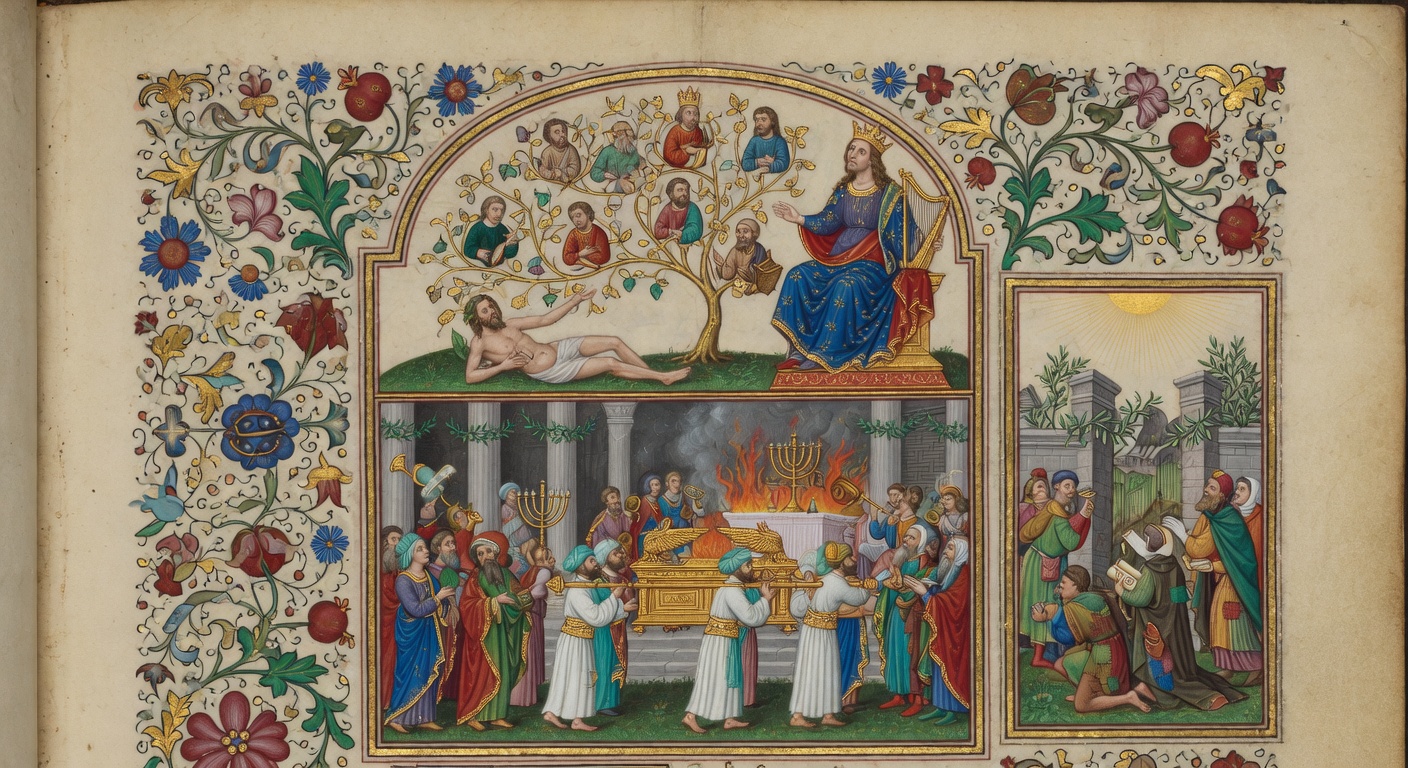
 1ow these are the divisions of the sons of Aaron. The sons of Aaron; Nadab, and Abihu, Eleazar, and Ithamar.
2 But Nadab and Abihu died before their father, and had no children: therefore Eleazar and Ithamar executed the priest’s office.
3 And David distributed them, both Zadok of the sons of Eleazar, and Ahimelech of the sons of Ithamar, according to their offices in their service.
4 And there were more chief men found of the sons of Eleazar than of the sons of Ithamar; and thus were they divided. Among the sons of Eleazar there were sixteen chief men of the house of their fathers, and eight among the sons of Ithamar according to the house of their fathers.
5 Thus were they divided by lot, one sort with another; for the governors of the sanctuary, and governors of the house of God, were of the sons of Eleazar, and of the sons of Ithamar.
6 And Shemaiah the son of Nethaneel the scribe, one of the Levites, wrote them before the king, and the princes, and Zadok the priest, and Ahimelech the son of Abiathar, and before the chief of the fathers of the priests and Levites: one principal household being taken for Eleazar, and one taken for Ithamar.
7 Now the first lot came forth to Jehoiarib, the second to Jedaiah,
8 The third to Harim, the fourth to Seorim,
9 The fifth to Malchijah, the sixth to Mijamin,
10 The seventh to Hakkoz, the eighth to Abijah,
11 The ninth to Jeshuah, the tenth to Shecaniah,
12 The eleventh to Eliashib, the twelfth to Jakim,
13 The thirteenth to Huppah, the fourteenth to Jeshebeab,
14 The fifteenth to Bilgah, the sixteenth to Immer,
15 The seventeenth to Hezir, the eighteenth to Aphses,
16 The nineteenth to Pethahiah, the twentieth to Jehezekel,
17 The one and twentieth to Jachin, the two and twentieth to Gamul,
18 The three and twentieth to Delaiah, the four and twentieth to Maaziah.
19 These were the orderings of them in their service to come into the house of the LORD, according to their manner, under Aaron their father, as the LORD God of Israel had commanded him.
20 And the rest of the sons of Levi were these: Of the sons of Amram; Shubael: of the sons of Shubael; Jehdeiah.
21 Concerning Rehabiah: of the sons of Rehabiah, the first was Isshiah.
22 Of the Izharites; Shelomoth: of the sons of Shelomoth; Jahath.
23 And the sons of Hebron; Jeriah the first, Amariah the second, Jahaziel the third, Jekameam the fourth.
24 Of the sons of Uzziel; Michah: of the sons of Michah; Shamir.
25 The brother of Michah was Isshiah: of the sons of Isshiah; Zechariah.
26 The sons of Merari were Mahli and Mushi: the sons of Jaaziah; Beno.
27 The sons of Merari by Jaaziah; Beno, and Shoham, and Zaccur, and Ibri.
28 Of Mahli came Eleazar, who had no sons.
29 Concerning Kish: the son of Kish was Jerahmeel.
30 The sons also of Mushi; Mahli, and Eder, and Jerimoth. These were the sons of the Levites after the house of their fathers.
31 These likewise cast lots over against their brethren the sons of Aaron in the presence of David the king, and Zadok, and Ahimelech, and the chief of the fathers of the priests and Levites, even the principal fathers over against their younger brethren.
← → arrow keys to navigate chapters · spacebar to play/pause audio
Did You Know?
The lot-casting for the 24 courses deliberately balanced the larger Eleazar line (16 divisions) against the smaller Ithamar line (8 divisions), a rare biblical instance of proportional representation achieved through sacred lots rather than mere genealogy.
The eighth course, Abijah, directly links this chapter to Luke 1, identifying the division in which Zechariah served and thereby anchoring the Chronicler’s temple organization to the events surrounding John the Baptist’s birth.
Jehoiarib heads the first course; this same family produced the Maccabees (1 Maccabees 2:1), meaning the priestly rotation established by David later supplied the leaders of the Hanukkah revolt centuries afterward.
David, Zadok, and Ahimelech jointly oversaw the allotment, an arrangement that fuses royal initiative with priestly authority and anticipates the post-exilic tension between Davidic and Aaronic roles in temple governance.
By recording that Nadab and Abihu left no sons, the chapter quietly preserves the memory of Leviticus 10’s judgment while showing how the surviving lines of Eleazar and Ithamar absorbed their forfeited inheritance, illustrating both consequence and continuity in priestly succession.
After Abihu and Nadab were struck down inside the tabernacle, their bodies had to be removed by their cousins Mishael and Elzaphan using their own tunics because Aaron and his remaining sons were barred from any public mourning rituals.
Historical analysis of priestly genealogies shows Ithamar's line eventually formed distinct divisions that handled subordinate sanctuary tasks, contrasting with the more prominent Eleazar lineage that produced the high priests.
In old age David could not keep warm even under heavy blankets, prompting his officials to bring the young Shunammite Abishag to lie beside him as a human heat source without becoming his wife.
Despite completing the temple, Solomon later built shrines to foreign deities like Ashtoreth, Chemosh, and Molech on the Mount of Olives for his 700 wives and 300 concubines, directly contributing to the kingdom's division after his death.
Jerusalem is mentioned over 800 times in the Bible. More than any other city.
This location became the focal point of national worship and divine promises, later extending symbolically to encompass the Temple Mount where Solomon built the house of the Lord.
Hebron is one of the oldest continuously inhabited cities in the world. Over 5,000 years old.
Commentary & Study Notes Jamieson-Fausset-Brown (1871) · Public Domain Now these are the divisions of the sons of Aaron — (See on 1Ch 23:6).
Classic verse-by-verse commentary on 1 Chronicles 24 from Jamieson, Fausset & Brown (1871). Covers: Division of the sons of aaron into four and twenty orders.
- 1
- Now these are the divisions of the sons of Aaron — (See on 1Ch 23:6).
- 2
- Nadab and Abihu died before their father — that is, not in his presence, but during his lifetime (see Nu 3:4; 26:61). therefore Eleazar and Ithamar executed the priest's office — In consequence of the death of his two oldest sons without issue, the descendants of Aaron were comprised in the families of Eleazar and Ithamar. Both of these sons discharged the priestly functions as assistants to their father. Eleazar succeeded him, and in his line the high priesthood continued until it was transferred to the family of Ithamar, in the person of Eli.
Read all 6 notes on 1 Chronicles 24 →