2 Timothy 2 KJV
A Good Soldier of Christ
A Good Soldier of Christ
The soldier metaphor in verse 4 alludes to Roman military regulations forbidding active-duty legionaries from engaging in business or civic offices, underscoring Paul’s call for single-minded detachment rather than a generic exhortation to perseverance.
 1hou therefore, my son, be strong in the grace that is in Christ Jesus.
2 And the things that thou hast heard of me among many witnesses, the same commit thou to faithful men, who shall be able to teach others also.
3 Thou therefore endure hardness, as a good soldier of Jesus Christ.
4 No man that warreth entangleth himself with the affairs of this life; that he may please him who hath chosen him to be a soldier.
5 And if a man also strive for masteries, yet is he not crowned, except he strive lawfully.
6 The husbandman that laboureth must be first partaker of the fruits.
7 Consider what I say; and the Lord give thee understanding in all things.
8 Remember that Jesus Christ of the seed of David was raised from the dead according to my gospel:
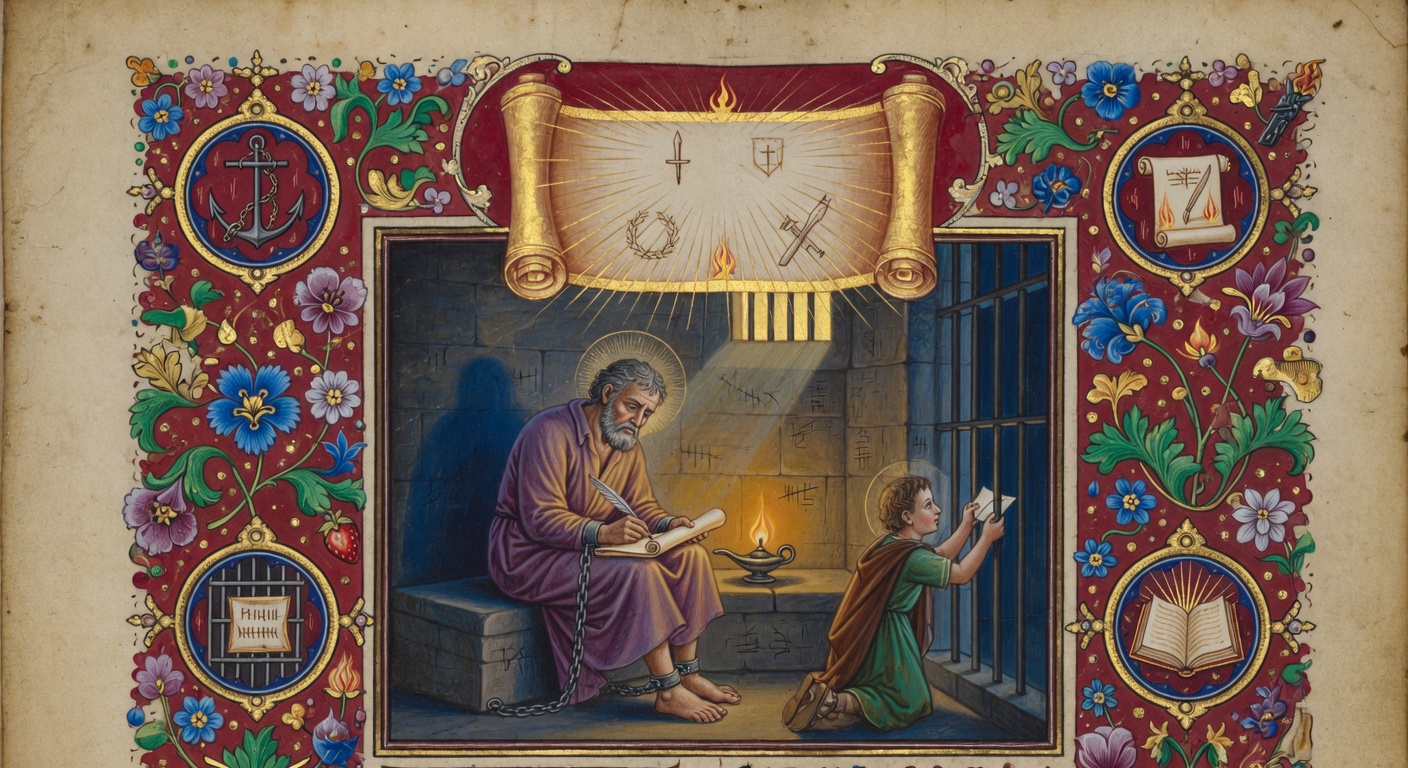
9 Wherein I suffer trouble, as an evil doer, even unto bonds; but the word of God is not bound.
10 Therefore I endure all things for the elect’s sakes, that they may also obtain the salvation which is in Christ Jesus with eternal glory.
11 It is a faithful saying: For if we be dead with him, we shall also live with him:
12 If we suffer, we shall also reign with him: if we deny him, he also will deny us:
13 If we believe not, yet he abideth faithful: he cannot deny himself.
14 Of these things put them in remembrance, charging them before the Lord that they strive not about words to no profit, but to the subverting of the hearers.
15 Study to shew thyself approved unto God, a workman that needeth not to be ashamed, rightly dividing the word of truth.
16 But shun profane and vain babblings: for they will increase unto more ungodliness.
17 And their word will eat as doth a canker: of whom is Hymenaeus and Philetus;
18 Who concerning the truth have erred, saying that the resurrection is past already; and overthrow the faith of some.
19 Nevertheless the foundation of God standeth sure, having this seal, The Lord knoweth them that are his. And, Let every one that nameth the name of Christ depart from iniquity.
20 But in a great house there are not only vessels of gold and of silver, but also of wood and of earth; and some to honour, and some to dishonour.
21 If a man therefore purge himself from these, he shall be a vessel unto honour, sanctified, and meet for the master’s use, and prepared unto every good work.
22 Flee also youthful lusts: but follow righteousness, faith, charity, peace, with them that call on the Lord out of a pure heart.
23 But foolish and unlearned questions avoid, knowing that they do gender strifes.
24 And the servant of the Lord must not strive; but be gentle unto all men, apt to teach, patient,
25 In meekness instructing those that oppose themselves; if God peradventure will give them repentance to the acknowledging of the truth;
26 And that they may recover themselves out of the snare of the devil, who are taken captive by him at his will.
← → arrow keys to navigate chapters · spacebar to play/pause audio
Did You Know?
The soldier metaphor in verse 4 alludes to Roman military regulations forbidding active-duty legionaries from engaging in business or civic offices, underscoring Paul’s call for single-minded detachment rather than a generic exhortation to perseverance.
Verses 11-13 preserve an early Christian liturgical fragment whose chiastic structure (suffering/reigning, denial/endurance) mirrors baptismal catechesis and may have been sung antiphonally, embedding resurrection hope within the threat of apostasy.
Paul’s citation of Numbers 16:5 (LXX) in verse 19 deliberately echoes the Korah rebellion, recasting the false teachers as modern-day rebels whose names are blotted from God’s sealed foundation.
The contrasting vessels of verse 20 evoke the stratified Roman domus, where gold, silver, wood, and clay utensils served distinct ritual and domestic functions; sanctification is thereby portrayed as a re-assignment of household role rather than mere moral cleansing.
Hymenaeus and Philetus’s claim that “the resurrection is past already” (v. 18) reflects an over-realized eschatology possibly influenced by Epicurean or proto-Gnostic ideas circulating in Ephesus, turning future hope into a present philosophical state.
Paul compares the spread of his teaching to gangrene ('will eat as doth a canker'), a vivid medical metaphor for how corrosive false doctrine can be to a congregation.
Paul studied under the renowned Pharisee Gamaliel in Jerusalem, receiving advanced training in Jewish law that he later referenced when defending his background before the Sanhedrin and in his epistles.
Paul's advice in 1 Timothy 5:23 for Timothy to drink a little wine for his frequent stomach ailments provides a rare glimpse into the personal health struggles of an early church leader.
Luke alone records the formal preface in Luke 1:1-4, where he states he carefully investigated everything from the beginning and wrote an orderly account based on eyewitness testimony, mirroring the methods of ancient Greco-Roman historians.
The riot in Ephesus lasted two hours with the crowd chanting 'Great is Artemis!'
The early Roman church met in homes. The first dedicated church buildings came centuries later.
Commentary & Study Notes Jamieson-Fausset-Brown (1871) · Public Domain Thou therefore — following my example (2Ti 1:8, 12), and that of ONESIPHORUS (2Ti 1:16-18), and shunning that of those who forsook me (2Ti 1:15). my son — Children ought to imitate…
Classic verse-by-verse commentary on 2 Timothy 2 from Jamieson, Fausset & Brown (1871). Covers: Exhortations; To faithfulness as a good soldier of Christ; Errors to be shunned; The Lord's sure foundation; The right spirit for a servant of Christ.
- 1
- Thou therefore — following my example (2Ti 1:8, 12), and that of ONESIPHORUS (2Ti 1:16-18), and shunning that of those who forsook me (2Ti 1:15). my son — Children ought to imitate their father. be strong — literally, "be invested with power." Have power, and show thyself to have it; implying an abiding state of power. in the grace — the element IN which the believer's strength has place. Compare 2Ti 1:7, "God hath given us the spirit of power."
- 2
- among — Greek, "through," that is, with the attestation (literally, "intervention") of many witnesses, namely, the presbyters and others present at his ordination or consecration (1Ti 4:14; 6:12). commit — in trust, as a deposit (2Ti 1:14). faithful — the quality most needed by those having a trust committed to them. who — Greek, "(persons) such as shall be competent to teach (them to) others also." Thus the way is prepared for inculcating the duty of faithful endurance (2Ti 2:3-13). Thou shouldest consider as a motive to endurance, that thou hast not only to keep the deposit for thyself, but to transmit it unimpaired to others, who in their turn shall fulfil the same office. This is so far from supporting oral tradition now that it rather teaches how precarious a mode of preserving revealed truth it was, depending, as it did, on the trustworthiness of each individual in the chain of succession; and how thankful we ought to be that God Himself has given the written Word, which is exempt from such risk.
Read all 26 notes on 2 Timothy 2 →