Acts 16 KJV
Paul's Second Missionary Journey
Paul's Second Missionary Journey
The chapter contains the first of the 'we' passages, marking Luke's presence with Paul from Troas onward and shifting the narrative to eyewitness testimony.
 1hen came he to Derbe and Lystra: and, behold, a certain disciple was there, named Timotheus, the son of a certain woman, which was a Jewess, and believed; but his father was a Greek:
2 Which was well reported of by the brethren that were at Lystra and Iconium.
3 Him would Paul have to go forth with him; and took and circumcised him because of the Jews which were in those quarters: for they knew all that his father was a Greek.
4 And as they went through the cities, they delivered them the decrees for to keep, that were ordained of the apostles and elders which were at Jerusalem.
5 And so were the churches established in the faith, and increased in number daily.
6 Now when they had gone throughout Phrygia and the region of Galatia, and were forbidden of the Holy Ghost to preach the word in Asia,
7 After they were come to Mysia, they assayed to go into Bithynia: but the Spirit suffered them not.
8 And they passing by Mysia came down to Troas.
9 And a vision appeared to Paul in the night; There stood a man of Macedonia, and prayed him, saying, Come over into Macedonia, and help us.
10 And after he had seen the vision, immediately we endeavoured to go into Macedonia, assuredly gathering that the Lord had called us for to preach the gospel unto them.
11 Therefore loosing from Troas, we came with a straight course to Samothracia, and the next day to Neapolis;
12 And from thence to Philippi, which is the chief city of that part of Macedonia, and a colony: and we were in that city abiding certain days.
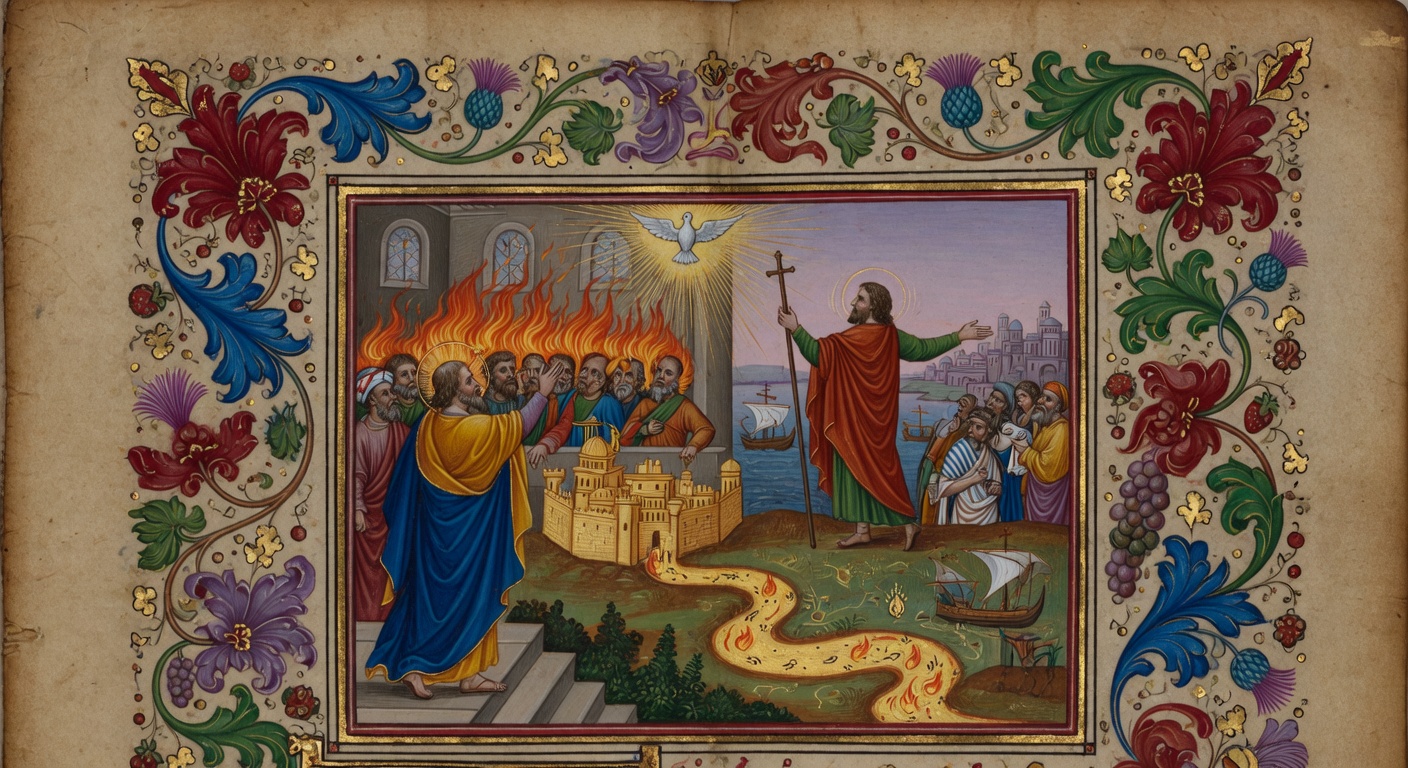
13 And on the sabbath we went out of the city by a river side, where prayer was wont to be made; and we sat down, and spake unto the women which resorted thither.
14 And a certain woman named Lydia, a seller of purple, of the city of Thyatira, which worshipped God, heard us: whose heart the Lord opened, that she attended unto the things which were spoken of Paul.
15 And when she was baptized, and her household, she besought us, saying, If ye have judged me to be faithful to the Lord, come into my house, and abide there. And she constrained us.
16 And it came to pass, as we went to prayer, a certain damsel possessed with a spirit of divination met us, which brought her masters much gain by soothsaying:
17 The same followed Paul and us, and cried, saying, These men are the servants of the most high God, which shew unto us the way of salvation.
18 And this did she many days. But Paul, being grieved, turned and said to the spirit, I command thee in the name of Jesus Christ to come out of her. And he came out the same hour.
19 And when her masters saw that the hope of their gains was gone, they caught Paul and Silas, and drew them into the marketplace unto the rulers,
20 And brought them to the magistrates, saying, These men, being Jews, do exceedingly trouble our city,
21 And teach customs, which are not lawful for us to receive, neither to observe, being Romans.
22 And the multitude rose up together against them: and the magistrates rent off their clothes, and commanded to beat them.
23 And when they had laid many stripes upon them, they cast them into prison, charging the jailor to keep them safely:
24 Who, having received such a charge, thrust them into the inner prison, and made their feet fast in the stocks.
25 And at midnight Paul and Silas prayed, and sang praises unto God: and the prisoners heard them.
26 And suddenly there was a great earthquake, so that the foundations of the prison were shaken: and immediately all the doors were opened, and every one’s bands were loosed.
27 And the keeper of the prison awaking out of his sleep, and seeing the prison doors open, he drew out his sword, and would have killed himself, supposing that the prisoners had been fled.
28 But Paul cried with a loud voice, saying, Do thyself no harm: for we are all here.
29 Then he called for a light, and sprang in, and came trembling, and fell down before Paul and Silas,
30 And brought them out, and said, Sirs, what must I do to be saved?
31 And they said, Believe on the Lord Jesus Christ, and thou shalt be saved, and thy house.
32 And they spake unto him the word of the Lord, and to all that were in his house.
33 And he took them the same hour of the night, and washed their stripes; and was baptized, he and all his, straightway.
34 And when he had brought them into his house, he set meat before them, and rejoiced, believing in God with all his house.
35 And when it was day, the magistrates sent the serjeants, saying, Let those men go.
36 And the keeper of the prison told this saying to Paul, The magistrates have sent to let you go: now therefore depart, and go in peace.
37 But Paul said unto them, They have beaten us openly uncondemned, being Romans, and have cast us into prison; and now do they thrust us out privily? nay verily; but let them come themselves and fetch us out.
38 And the serjeants told these words unto the magistrates: and they feared, when they heard that they were Romans.
39 And they came and besought them, and brought them out, and desired them to depart out of the city.
40 And they went out of the prison, and entered into the house of Lydia: and when they had seen the brethren, they comforted them, and departed.
← → arrow keys to navigate chapters · spacebar to play/pause audio
Did You Know?
The chapter contains the first of the 'we' passages, marking Luke's presence with Paul from Troas onward and shifting the narrative to eyewitness testimony.
The slave girl's spirit is literally called 'Python' in the Greek, directly evoking the Delphic oracle of Apollo and framing her exorcism as a confrontation with pagan prophetic authority.
Paul circumcises Timothy immediately after the Jerusalem Council, demonstrating strategic flexibility in mission work to avoid unnecessary offense to Jewish audiences despite Gentile exemption from the law.
Lydia, a dealer in purple from Thyatira, becomes Europe's first named convert, forging a link to the church later addressed in Revelation 2 and highlighting economic networks in early Christian expansion.
The earthquake loosens every prisoner's bonds yet none flee, creating a reversal where the jailer seeks salvation from those he guarded, underscoring themes of unexpected divine reversal and household inclusion.
The so-called "we" passages beginning in Acts 16:10 indicate that Luke joined Paul's missionary team at Troas and accompanied him on the voyage to Macedonia, providing an eyewitness perspective on key events.
Described in Acts 16:14 as a "worshiper of God," Lydia belonged to the class of Gentile God-fearers who attended synagogue-style prayer meetings without full conversion to Judaism, allowing Paul to address her directly at the Philippi riverside.
As a recognized prophet in the Jerusalem church, Silas was chosen alongside Judas Barsabbas to deliver the apostolic decree from the Council to Gentile congregations in Antioch, underscoring his role in mediating the inclusion of non-Jews without requiring full circumcision.
Timothy's mixed heritage. Jewish mother Eunice and Greek father. Made him uniquely positioned to bridge cultural divides in the early church, a detail Paul leveraged for effective evangelism among both groups.
This led Paul to sail immediately to Philippi in Macedonia, marking the first recorded spread of Christianity into Europe.
In the letter, Paul defends justification by faith alone as the heart of the gospel, recounting his own apostolic authority and the Jerusalem council’s decision on Gentile inclusion.
An earthquake miraculously opened the prison doors, leading to the jailer’s conversion and the church’s growth amid persecution.
Commentary & Study Notes Jamieson-Fausset-Brown (1871) · Public Domain Now when they had gone throughout Phrygia and the region of Galatia — proceeding in a northwesterly direction. At this time must have been formed "the churches of Galatia" (Ga 1:2;…
Classic verse-by-verse commentary on Acts 16 from Jamieson, Fausset & Brown (1871). Covers: They break new ground in phrygia and galatia--their course in that direction being mysteriously hedged up, they travel westward to troas, where they are divinely directed to macedonia--the historian himself here joining the missionary party, they embark for neapolis, and reach philippi; At philippi, lydia is gained and with her household baptized--an evil spirit is expelled, paul and silas are scourged, imprisoned, and manacled, but miraculously set free, and the jailer with all his household converted and baptized.
- 6-8
- Now when they had gone throughout Phrygia and the region of Galatia — proceeding in a northwesterly direction. At this time must have been formed "the churches of Galatia" (Ga 1:2; 1Co 16:1); founded, as we learn from the Epistle to the Galatians (particularly Ga 4:19), by the apostle Paul, and which were already in existence when he was on his third missionary journey, as we learn from Ac 18:23, where it appears that he was no less successful in Phrygia. Why these proceedings, so interesting as we should suppose, are not here detailed, it is not easy to say; for the various reasons suggested are not very satisfactory: for example, that the historian had not joined the party [ALFORD]; that he was in haste to bring the apostle to Europe [OLSHAUSEN]; that the main stream of the Church's development was from Jerusalem to Rome, and the apostle's labors in Phrygia and Galatia lay quite out of the line of that direction [BAUMGARTEN]. and were forbidden of the Holy Ghost — speaking by some prophet, see on Ac 11:27. to preach the word in Asia — not the great Asiatic continent, nor even the rich peninsula now called Asia Minor, but only so much of its western coast as constituted the Roman province of Asia.
- 7
- After they were come to Mysia — where, as being part of Roman Asia, they were forbidden to labor (Ac 16:8). they assayed — or attempted to go into — or, towards. Bithynia — to the northeast. but the Spirit — speaking as before. suffered them not — probably because, (1) Europe was ripe for the labors of this missionary party; and (2) other instruments were to be honored to establish the Gospel in the eastern regions of Asia Minor, especially the apostle Peter (see 1Pe 1:1). By the end of the first century, as testified by PLINY the governor, Bithynia was filled with Christians. "This is the first time that the Holy Ghost is expressly spoken of as determining the course they were to follow in their efforts to evangelize the nations, and it was evidently designed to show that whereas hitherto the diffusion of the Gospel had been carried on in unbroken course, connected by natural points of junction, it was now to take a leap to which it could not be impelled but by an immediate and independent operation of the Spirit; and though primarily, this intimation of the Spirit was only negative, and referred but to the immediate neighborhood, we may certainly conclude that Paul took it for a sign that a new epoch was now to commence in his apostolic labors" [BAUMGARTEN].
Read all 36 notes on Acts 16 →