Esther 7 KJV
Haman Hanged
Haman Hanged
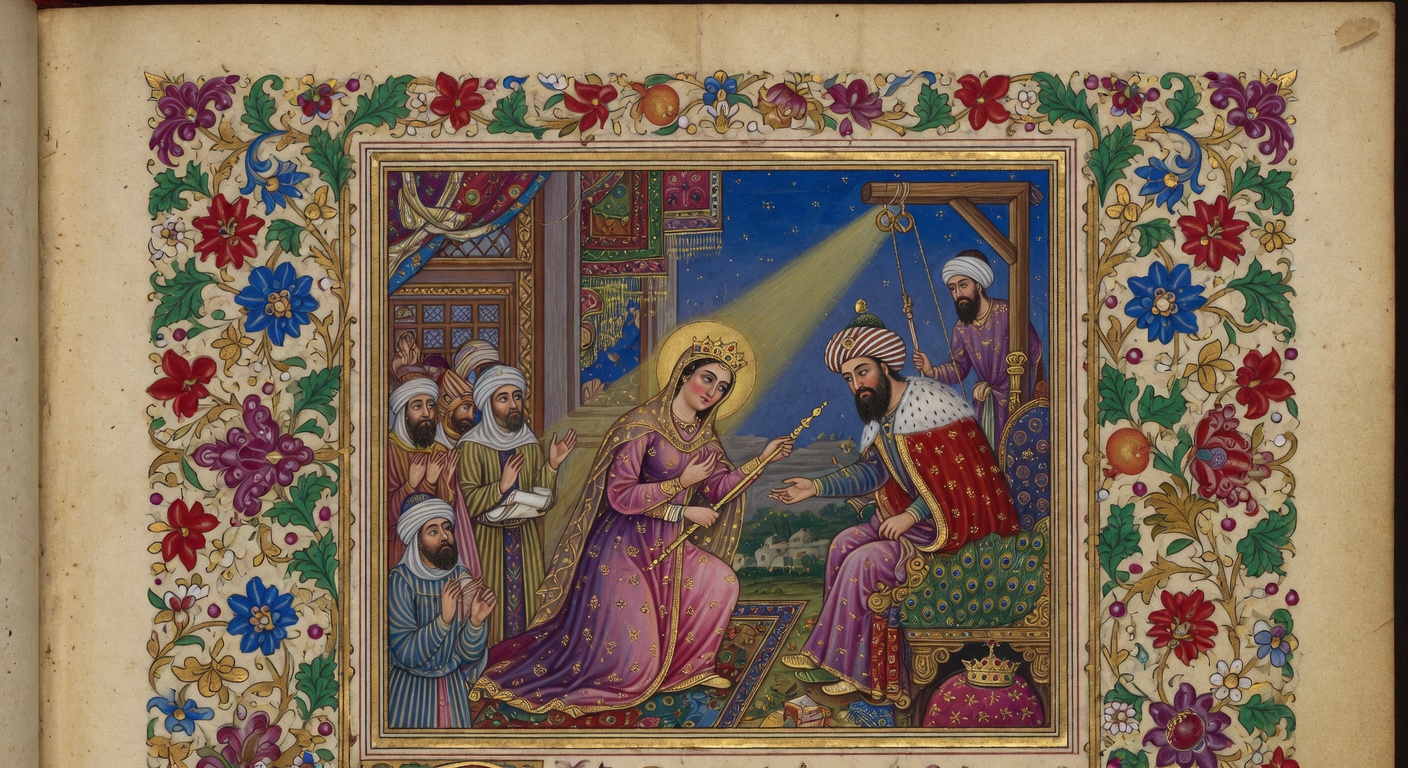
The chapter's pivotal reversal occurs when the gallows Haman erected specifically for Mordecai. Measuring fifty cubits and visible from the palace. Becomes the instrument of his own execution, embodying an ironic 'lex talionis' that echoes earlier biblical patterns like those in Genesis 50 without any explicit divine speech.
 1o the king and Haman came to banquet with Esther the queen.
2 And the king said again unto Esther on the second day at the banquet of wine, What is thy petition, queen Esther? and it shall be granted thee: and what is thy request? and it shall be performed, even to the half of the kingdom.
3 Then Esther the queen answered and said, If I have found favour in thy sight, O king, and if it please the king, let my life be given me at my petition, and my people at my request:
4 For we are sold, I and my people, to be destroyed, to be slain, and to perish. But if we had been sold for bondmen and bondwomen, I had held my tongue, although the enemy could not countervail the king’s damage.
5 Then the king Ahasuerus answered and said unto Esther the queen, Who is he, and where is he, that durst presume in his heart to do so?
6 And Esther said, The adversary and enemy is this wicked Haman. Then Haman was afraid before the king and the queen.
7 And the king arising from the banquet of wine in his wrath went into the palace garden: and Haman stood up to make request for his life to Esther the queen; for he saw that there was evil determined against him by the king.
8 Then the king returned out of the palace garden into the place of the banquet of wine; and Haman was fallen upon the bed whereon Esther was. Then said the king, Will he force the queen also before me in the house? As the word went out of the king’s mouth, they covered Haman’s face.
9 And Harbonah, one of the chamberlains, said before the king, Behold also, the gallows fifty cubits high, which Haman had made for Mordecai, who had spoken good for the king, standeth in the house of Haman. Then the king said, Hang him thereon.
10 So they hanged Haman on the gallows that he had prepared for Mordecai. Then was the king’s wrath pacified.
← → arrow keys to navigate chapters · spacebar to play/pause audio
Did You Know?
The chapter's pivotal reversal occurs when the gallows Haman erected specifically for Mordecai. Measuring fifty cubits and visible from the palace. Becomes the instrument of his own execution, embodying an ironic 'lex talionis' that echoes earlier biblical patterns like those in Genesis 50 without any explicit divine speech.
Esther's strategic decision to accuse Haman at the second banquet rather than the first exploits Persian royal protocol, where the king's fury is deliberately stoked in a private setting before witnesses, preventing any perception that she is challenging the unalterable decree of chapter 3.
Haman's prostration on Esther's couch is interpreted by Ahasuerus not merely as a sexual advance but as a direct violation of harem sanctity, a capital crime in Achaemenid court etiquette that transforms Haman's plea for mercy into the precise trigger for his doom.
The otherwise minor courtier Harbonah's sudden intervention naming the gallows links the personal feud between Mordecai and Haman (rooted in the Amalekite-Agagite enmity of 1 Samuel 15) to the machinery of state justice, revealing how private grudges infiltrate imperial administration.
Ahasuerus's abrupt exit to the palace garden functions as a narrative device mirroring his earlier insomnia in chapter 6, allowing the plot's momentum to pivot from verbal accusation to physical action and underscoring the king's volatile temperament as an unwitting agent of providence.
Candidates for queen, including Esther, underwent a mandatory twelve-month regimen of myrrh oil and cosmetic treatments before entering the king's presence, illustrating Achaemenid court protocols for royal consorts.
Haman pledged 10,000 talents of silver. Roughly two-thirds of the Persian Empire's yearly tax revenue. To the royal treasury to cover the costs of the planned massacre, an offer recorded in Esther 3:9.
Positioned daily at the king's gate in Susa, Mordecai overheard and reported the assassination plot by eunuchs Bigthan and Teresh, an act recorded in the royal chronicles that later saved Ahasuerus's life and elevated his status.
Young women selected for the king's harem, including Esther, underwent a mandatory twelve-month beauty regimen consisting of six months with oil of myrrh followed by six months with perfumes and cosmetics, reflecting documented ancient Persian practices of prolonged preparation before entering the royal presence.
Through these accounts Persia reveals how the Lord sovereignly directs even mighty Gentile kingdoms to preserve his people and advance the promises of restoration.
Commentary & Study Notes Jamieson-Fausset-Brown (1871) · Public Domain 4. we are sold, I and my people, to be destroyed — that is, by the cruel and perfidious scheme of that man, who offered an immense sum of money to purchase our extermination. Esthe…
Classic verse-by-verse commentary on Esther 7 from Jamieson, Fausset & Brown (1871). Covers: Esther pleads for her own life and the life of her people; The king causes haman to be hanged on his own gallows.
- 7
- he saw that there was evil determined against him by the king — When the king of Persia orders an offender to be executed, and then rises and goes into the women's apartment, it is a sign that no mercy is to be hoped for. Even the sudden rising of the king in anger was the same as if he had pronounced sentence.
- 8
- Haman was fallen upon the bed whereon Esther was — We do not know the precise form of the couches on which the Persians reclined at table. But it is probable that they were not very different from those used by the Greeks and Romans. Haman, perhaps, at first stood up to beg pardon of Esther; but driven in his extremity to resort to an attitude of the most earnest supplication, he fell prostrate on the couch where the queen was recumbent. The king returning that instant was fired at what seemed an outrage on female modesty. they covered Haman's face — The import of this striking action is, that a criminal is unworthy any longer to look on the face of the king, and hence, when malefactors are consigned to their doom in Persia, the first thing is to cover the face with a veil or napkin.
Read all 4 notes on Esther 7 →