Exodus 22 KJV
Laws of Restitution
Laws of Restitution
The restitution laws for stolen livestock (vv. 1-4) escalate penalties based on the animal's productive value. An ox requiring fivefold repayment versus fourfold for a sheep. Reflecting an agrarian economy where an ox's loss disrupts plowing capacity far more than a sheep's.
 1f a man shall steal an ox, or a sheep, and kill it, or sell it; he shall restore five oxen for an ox, and four sheep for a sheep.
2 If a thief be found breaking up, and be smitten that he die, there shall no blood be shed for him.
3 If the sun be risen upon him, there shall be blood shed for him; for he should make full restitution; if he have nothing, then he shall be sold for his theft.
4 If the theft be certainly found in his hand alive, whether it be ox, or ass, or sheep; he shall restore double.
5 If a man shall cause a field or vineyard to be eaten, and shall put in his beast, and shall feed in another man’s field; of the best of his own field, and of the best of his own vineyard, shall he make restitution.
6 If fire break out, and catch in thorns, so that the stacks of corn, or the standing corn, or the field, be consumed therewith; he that kindled the fire shall surely make restitution.
7 If a man shall deliver unto his neighbour money or stuff to keep, and it be stolen out of the man’s house; if the thief be found, let him pay double.
8 If the thief be not found, then the master of the house shall be brought unto the judges, to see whether he have put his hand unto his neighbour’s goods.
9 For all manner of trespass, whether it be for ox, for ass, for sheep, for raiment, or for any manner of lost thing, which another challengeth to be his, the cause of both parties shall come before the judges; and whom the judges shall condemn, he shall pay double unto his neighbour.
10 If a man deliver unto his neighbour an ass, or an ox, or a sheep, or any beast, to keep; and it die, or be hurt, or driven away, no man seeing it:
11 Then shall an oath of the LORD be between them both, that he hath not put his hand unto his neighbour’s goods; and the owner of it shall accept thereof, and he shall not make it good.
12 And if it be stolen from him, he shall make restitution unto the owner thereof.
13 If it be torn in pieces, then let him bring it for witness, and he shall not make good that which was torn.
14 And if a man borrow ought of his neighbour, and it be hurt, or die, the owner thereof being not with it, he shall surely make it good.
15 But if the owner thereof be with it, he shall not make it good: if it be an hired thing, it came for his hire.
16 And if a man entice a maid that is not betrothed, and lie with her, he shall surely endow her to be his wife.
17 If her father utterly refuse to give her unto him, he shall pay money according to the dowry of virgins.
18 Thou shalt not suffer a witch to live.
19 Whosoever lieth with a beast shall surely be put to death.
20 He that sacrificeth unto any god, save unto the LORD only, he shall be utterly destroyed.
21 Thou shalt neither vex a stranger, nor oppress him: for ye were strangers in the land of Egypt.
22 Ye shall not afflict any widow, or fatherless child.
23 If thou afflict them in any wise, and they cry at all unto me, I will surely hear their cry;
24 And my wrath shall wax hot, and I will kill you with the sword; and your wives shall be widows, and your children fatherless.
25 If thou lend money to any of my people that is poor by thee, thou shalt not be to him as an usurer, neither shalt thou lay upon him usury.
26 If thou at all take thy neighbour’s raiment to pledge, thou shalt deliver it unto him by that the sun goeth down:
27 For that is his covering only, it is his raiment for his skin: wherein shall he sleep? and it shall come to pass, when he crieth unto me, that I will hear; for I am gracious.
28 Thou shalt not revile the gods, nor curse the ruler of thy people.
29 Thou shalt not delay to offer the first of thy ripe fruits, and of thy liquors: the firstborn of thy sons shalt thou give unto me.
30 Likewise shalt thou do with thine oxen, and with thy sheep: seven days it shall be with his dam; on the eighth day thou shalt give it me.
31 And ye shall be holy men unto me: neither shall ye eat any flesh that is torn of beasts in the field; ye shall cast it to the dogs.
← → arrow keys to navigate chapters · spacebar to play/pause audio
Did You Know?
The restitution laws for stolen livestock (vv. 1-4) escalate penalties based on the animal's productive value. An ox requiring fivefold repayment versus fourfold for a sheep. Reflecting an agrarian economy where an ox's loss disrupts plowing capacity far more than a sheep's.
God's warning that He will hear the cry of the oppressed stranger, widow, or orphan (vv. 22-24) deliberately echoes the language of Israel's own deliverance from Egypt, framing social ethics as an extension of the Exodus narrative itself.
The seduction law (vv. 16-17) places the financial penalty on the man while granting the father sole authority over whether marriage occurs, revealing a system that treats the daughter's value as tied to her father's household rather than her own consent.
Prohibitions against charging interest (v. 25) apply only within the covenant community, creating an economic boundary that treats fellow Israelites as family rather than market participants, a distinction absent from many ancient Near Eastern codes.
The command not to revile judges or curse rulers (v. 28) immediately follows laws on idolatry and sorcery, implying that undermining divinely appointed authorities constitutes a parallel threat to monotheistic loyalty.
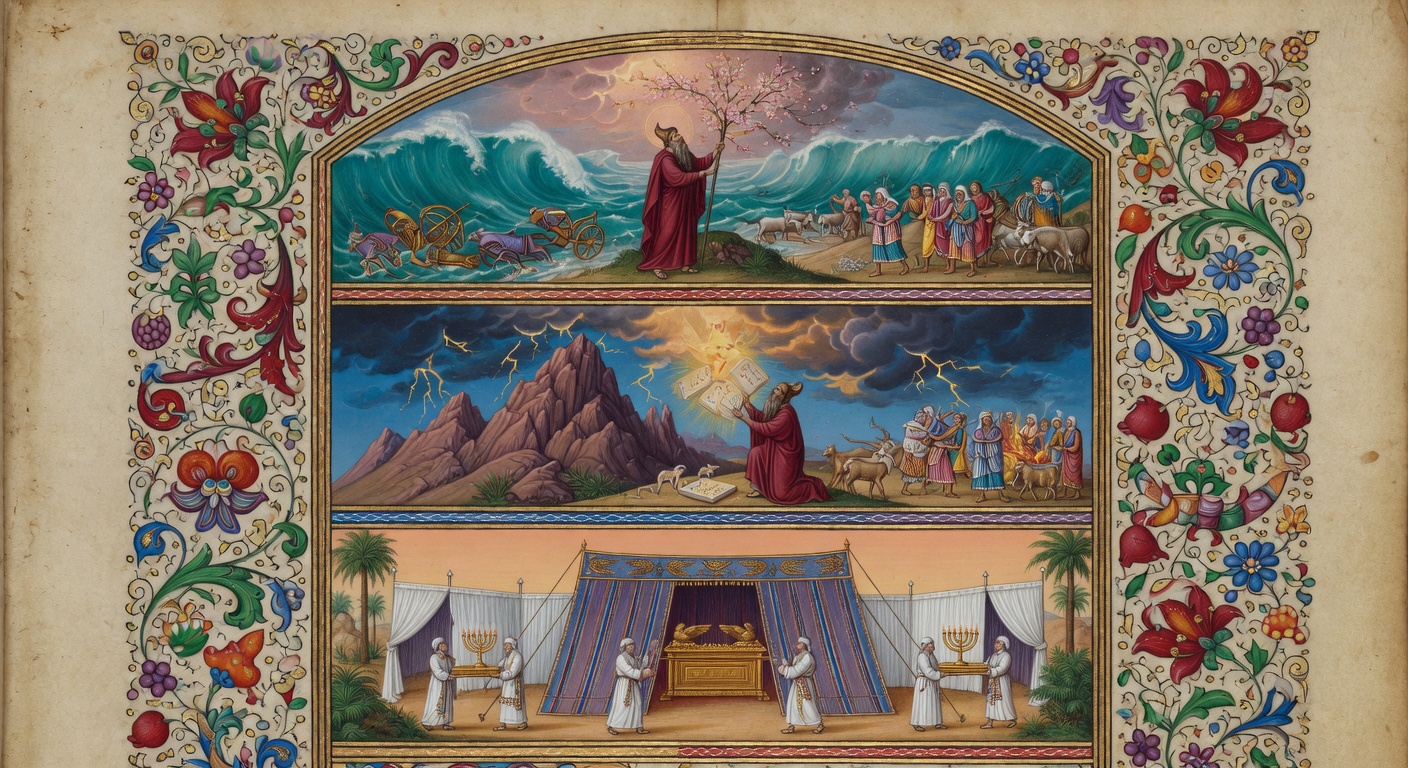
Upon descending Mount Sinai with the second tablets, Moses' face emitted such intense radiance from his direct encounter with God that he was forced to wear a veil when addressing the Israelites, a detail highlighting ancient Near Eastern concepts of divine glory as physically transformative.
The high priestly garments designed for Aaron included a breastplate with twelve precious stones representing the tribes of Israel and an ephod woven with gold thread, reflecting both tribal unity and divine craftsmanship in ancient Israelite worship.
The hardening of Pharaoh's heart is described as occurring both through his own volition and divine intervention at different points, underscoring a nuanced theological interplay between human agency and sovereignty in the Exodus account.
In Numbers 12, Miriam joins Aaron in challenging Moses' exclusive prophetic authority over his marriage to a Cushite woman, resulting in her being struck with leprosy while Aaron receives only a rebuke, underscoring gender disparities in the narrative.
Egypt is mentioned over 700 times in the Bible.
If the Israelites crossed in a column 50 people wide, the crossing would have taken about 9 hours.
The exact location of Mount Sinai is still debated among scholars.
Commentary & Study Notes Jamieson-Fausset-Brown (1871) · Public Domain If a man shall steal an ox, or a sheep — The law respects the theft of cattle which constituted the chief part of their property. The penalty for the theft of a sheep which was sla…
Classic verse-by-verse commentary on Exodus 22 from Jamieson, Fausset & Brown (1871). Covers: Laws concerning theft.
- 1-4
- If a man shall steal an ox, or a sheep — The law respects the theft of cattle which constituted the chief part of their property. The penalty for the theft of a sheep which was slain or sold, was fourfold; for an ox fivefold, because of its greater utility in labor; but, should the stolen animal have been recovered alive, a double compensation was all that was required, because it was presumable he (the thief) was not a practised adept in dishonesty. A robber breaking into a house at midnight might, in self-defense, be slain with impunity; but if he was slain after sunrise, it would be considered murder, for it was not thought likely an assault would then be made upon the lives of the occupants. In every case where a thief could not make restitution, he was sold as a slave for the usual term.
- 6
- If fire break out, and catch in thorns — This refers to the common practice in the East of setting fire to the dry grass before the fall of the autumnal rains, which prevents the ravages of vermin, and is considered a good preparation of the ground for the next crop. The very parched state of the herbage and the long droughts of summer, make the kindling of a fire an operation often dangerous, and always requiring caution from its liability to spread rapidly. stacks — or as it is rendered "shocks" (Jud 15:5; Job 5:26), means simply a bundle of loose sheaves.
Read all 4 notes on Exodus 22 →