Hosea 10 KJV
Israel's Sin and Captivity
Israel's Sin and Captivity
Hosea 10:2’s phrase 'their heart is divided' employs a Hebrew term elsewhere rendered 'flattering' or 'smooth,' implying that Israel’s worship is not merely double-minded but actively deceptive, a nuance lost in most English renderings.
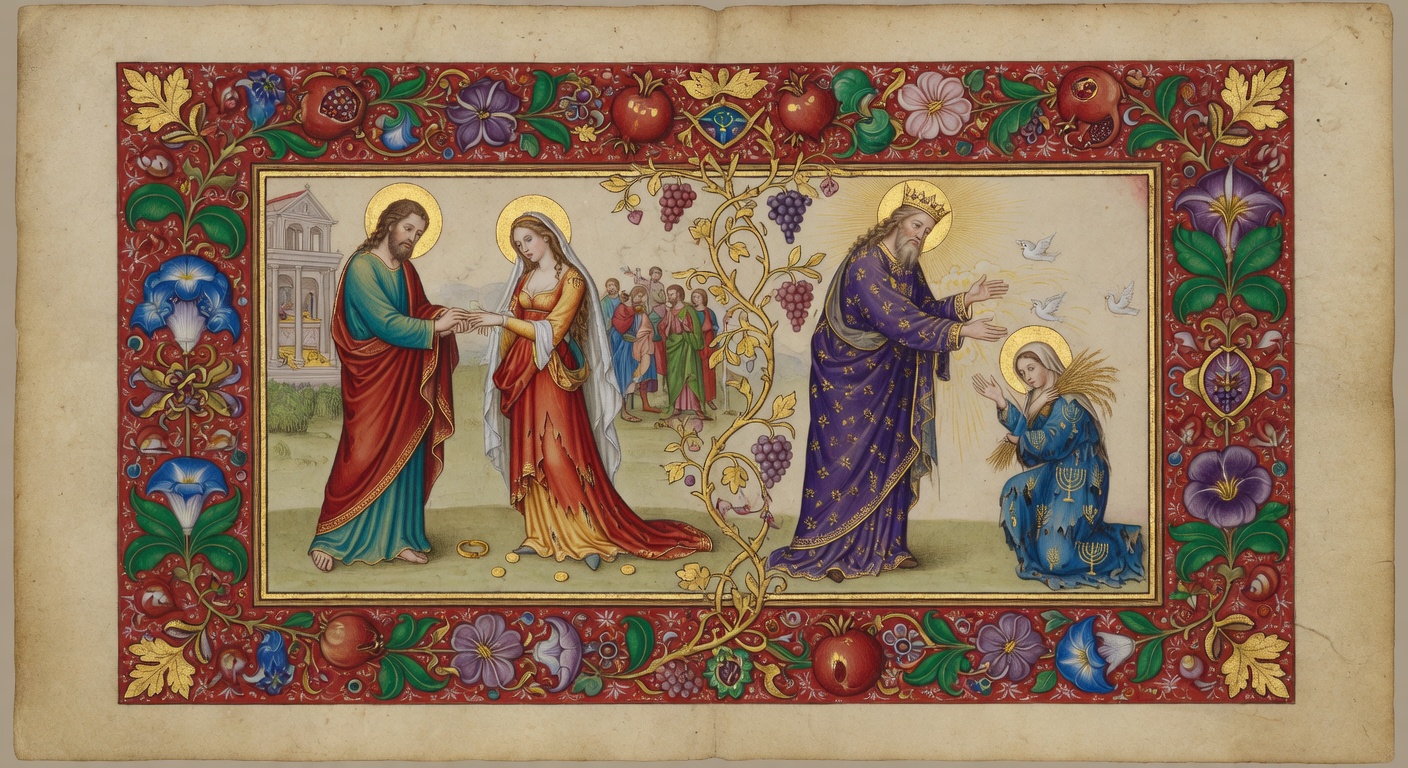
 1srael is an empty vine, he bringeth forth fruit unto himself: according to the multitude of his fruit he hath increased the altars; according to the goodness of his land they have made goodly images.
2 Their heart is divided; now shall they be found faulty: he shall break down their altars, he shall spoil their images.
3 For now they shall say, We have no king, because we feared not the LORD; what then should a king do to us?
4 They have spoken words, swearing falsely in making a covenant: thus judgment springeth up as hemlock in the furrows of the field.
5 The inhabitants of Samaria shall fear because of the calves of Bethaven: for the people thereof shall mourn over it, and the priests thereof that rejoiced on it, for the glory thereof, because it is departed from it.
6 It shall be also carried unto Assyria for a present to king Jareb: Ephraim shall receive shame, and Israel shall be ashamed of his own counsel.
7 As for Samaria, her king is cut off as the foam upon the water.
8 The high places also of Aven, the sin of Israel, shall be destroyed: the thorn and the thistle shall come up on their altars; and they shall say to the mountains, Cover us; and to the hills, Fall on us.
9 O Israel, thou hast sinned from the days of Gibeah: there they stood: the battle in Gibeah against the children of iniquity did not overtake them.
10 It is in my desire that I should chastise them; and the people shall be gathered against them, when they shall bind themselves in their two furrows.
11 And Ephraim is as an heifer that is taught, and loveth to tread out the corn; but I passed over upon her fair neck: I will make Ephraim to ride; Judah shall plow, and Jacob shall break his clods.
12 Sow to yourselves in righteousness, reap in mercy; break up your fallow ground: for it is time to seek the LORD, till he come and rain righteousness upon you.
13 Ye have plowed wickedness, ye have reaped iniquity; ye have eaten the fruit of lies: because thou didst trust in thy way, in the multitude of thy mighty men.
14 Therefore shall a tumult arise among thy people, and all thy fortresses shall be spoiled, as Shalman spoiled Betharbel in the day of battle: the mother was dashed in pieces upon her children.
15 So shall Bethel do unto you because of your great wickedness: in a morning shall the king of Israel utterly be cut off.
← → arrow keys to navigate chapters · spacebar to play/pause audio
Did You Know?
Hosea 10:2’s phrase 'their heart is divided' employs a Hebrew term elsewhere rendered 'flattering' or 'smooth,' implying that Israel’s worship is not merely double-minded but actively deceptive, a nuance lost in most English renderings.
The chapter’s sole reference to 'the sin of Gibeah' (v. 9) deliberately re-activates the Judges 19-21 narrative of civil war and near-genocide, framing the northern kingdom’s contemporary idolatry as a continuation of Benjamin’s ancient outrage rather than a new development.
Verse 7’s image of the king 'cut off as the foam upon the water' is the only biblical occurrence of this particular metaphor for evanescence; the term for 'foam' (qetseph) elsewhere denotes divine wrath, creating an ironic double sense of both transience and judgment.
The command in v. 12 to 'sow to yourselves in righteousness' stands as the sole positive agricultural imperative in Hosea, inverting the chapter’s dominant vine-to-thorn trajectory and anticipating the eschatological 'raining righteousness' that later Jewish and Christian interpreters linked to messianic renewal.
Verse 8’s plea 'mountains, cover us; hills, fall on us' is the only Old Testament text Jesus directly quotes concerning the fall of Jerusalem (Luke 23:30), while Revelation 6:16 reuses it for cosmic judgment, establishing Hosea 10 as the literary bridge between prophetic and apocalyptic usage of this cry.
Hosea, the only writing prophet from Israel's northern kingdom, directed his oracles primarily against the house of Jehu during the chaotic final decades before Assyria's conquest of Samaria in 722 BC.
Longstanding ethnic and religious tensions led Jews to avoid travel through Samaria and to view its inhabitants with hostility and suspicion.
Egypt is mentioned over 700 times in the Bible.
Commentary & Study Notes Jamieson-Fausset-Brown (1871) · Public Domain 1. empty — stripped of its fruits [CALVIN], (Na 2:2); compelled to pay tribute to Pul (2Ki 15:20). MAURER translates, "A widespreading vine"; so the Septuagint. Compare Ge 49:22; P…
Classic verse-by-verse commentary on Hosea 10 from Jamieson, Fausset & Brown (1871). Covers: Israel's idolatry, the source of perjuries and unlawful leagues, soon destined to be the ruin of the state, their king and their images being about to be carried off; A just chastisement, the reaping corresponding to the sowing.
- 13
- 1. empty — stripped of its fruits [CALVIN], (Na 2:2); compelled to pay tribute to Pul (2Ki 15:20). MAURER translates, "A widespreading vine"; so the Septuagint. Compare Ge 49:22; Ps 80:9-11; Eze 17:6. bringeth forth fruit unto himself — not unto ME. according to... multitude of... fruit... increased... altars — In proportion to the abundance of their prosperity, which called for fruit unto God (compare Ro 6:22), was the abundance of their idolatry (Ho 8:4, 11).
- 2
- heart... divided — (1Ki 18:21; Mt 6:24; Jas 4:8). now — that is, soon. he — Jehovah. break down — "cut off," namely the heads of the victims. Those altars, which were the scene of cutting off the victims' heads, shall be themselves cut off.
Read all 15 notes on Hosea 10 →