Hosea 3 KJV
Hosea Redeems His Wife
Hosea Redeems His Wife
The redemption price of fifteen shekels of silver plus a homer and half of barley equals half the valuation of a male slave in Exodus 21:32, framing Gomer's purchase as a deliberate echo of manumission law that casts Israel's covenant relationship as indentured servitude awaiting divine release.
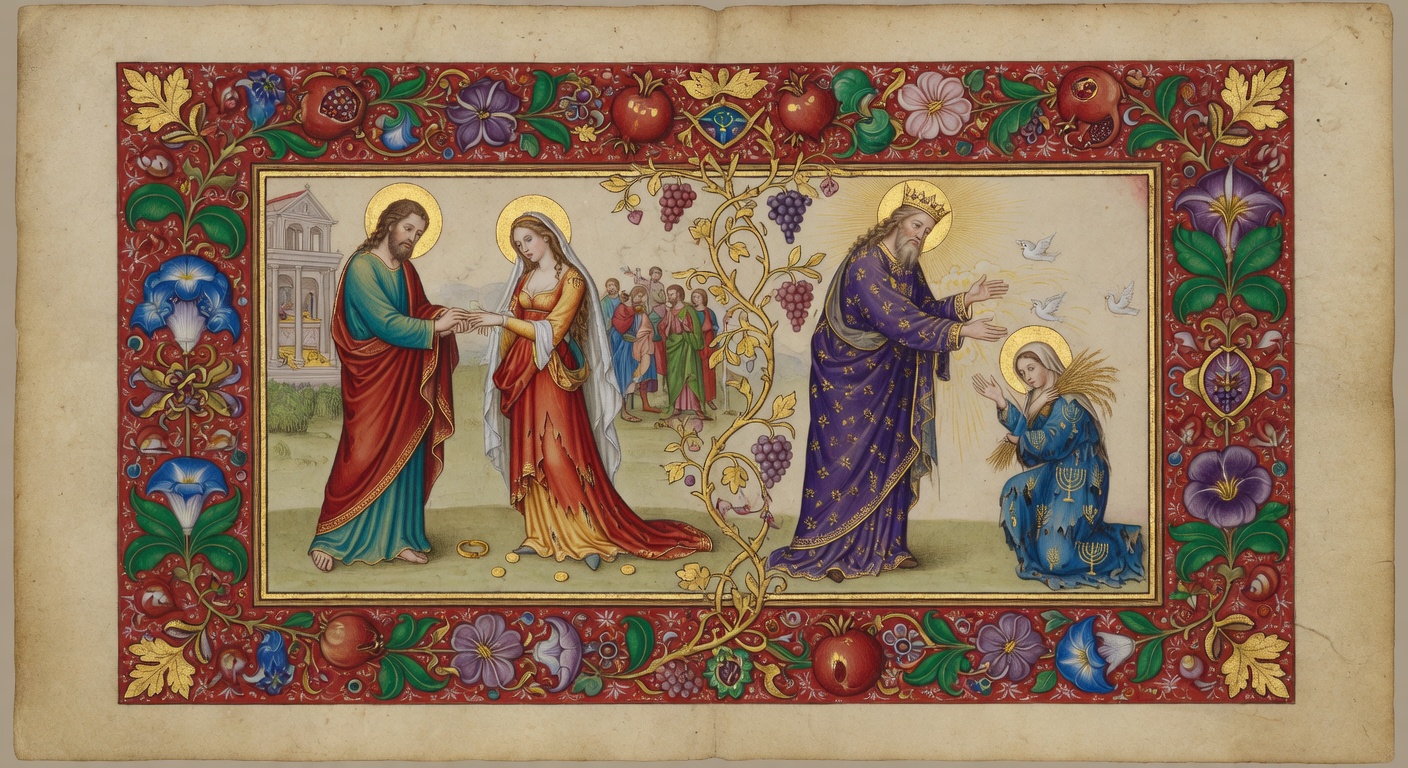
 1hen said the LORD unto me, Go yet, love a woman beloved of her friend, yet an adulteress, according to the love of the LORD toward the children of Israel, who look to other gods, and love flagons of wine.
2 So I bought her to me for fifteen pieces of silver, and for an homer of barley, and an half homer of barley:
3 And I said unto her, Thou shalt abide for me many days; thou shalt not play the harlot, and thou shalt not be for another man: so will I also be for thee.
4 For the children of Israel shall abide many days without a king, and without a prince, and without a sacrifice, and without an image, and without an ephod, and without teraphim:
5 Afterward shall the children of Israel return, and seek the LORD their God, and David their king; and shall fear the LORD and his goodness in the latter days.
← → arrow keys to navigate chapters · spacebar to play/pause audio
Did You Know?
The redemption price of fifteen shekels of silver plus a homer and half of barley equals half the valuation of a male slave in Exodus 21:32, framing Gomer's purchase as a deliberate echo of manumission law that casts Israel's covenant relationship as indentured servitude awaiting divine release.
The explicit command to 'love' the adulteress employs the same verb root ('ahav) used for YHWH's election of Israel in Deuteronomy 7:8, collapsing the distinction between Hosea's personal obedience and the deity's unchanging covenantal affection.
The 'many days' without king, prince, sacrifice, pillar, ephod or teraphim (v. 4) functions as an internal prophecy of cultic and monarchic deprivation that later Jewish readers mapped onto both the Assyrian deportations and the destruction of the Second Temple.
Gomer is never named in this chapter and is instead introduced only as 'a woman beloved of her friend, yet an adulteress,' a deliberate depersonalization that universalizes the figure and prevents the narrative from being read as mere domestic anecdote.
The chapter's final clause ('and shall return [shuv] to seek YHWH their God') reuses the key verb of repentance that structures the entire book, creating a lexical bridge between the biographical sign-act and the later calls to national return in chapters 6 and 14.
Hosea 2:16 contains the earliest prophetic announcement that Israel would one day cease addressing God as 'my Baal' (master) and instead call him 'my Ish' (husband), deliberately subverting Baal fertility-cult language.
God commanded the prophet Hosea to marry Gomer, an unfaithful woman, so that his own marriage would become a living sermon about Israel's spiritual adultery (Hosea 1:2).
This account illustrates Scripture’s emphasis on the extension of salvation beyond Jewish boundaries and Jesus’ willingness to cross social barriers to reveal truth.
The Israelites lived in Egypt for approximately 430 years.
Commentary & Study Notes Jamieson-Fausset-Brown (1871) · Public Domain Go yet — "Go again," referring to Ho 1:2 [HENDERSON]. a woman — purposely indefinite, for thy wife, to express the separation in which Hosea had lived from Gomer for her unfaithful…
Classic verse-by-verse commentary on Hosea 3 from Jamieson, Fausset & Brown (1871). Covers: Israel's condition in their present dispersion, subsequent to their return from Babylon, symbolized.
- 1
- Go yet — "Go again," referring to Ho 1:2 [HENDERSON]. a woman — purposely indefinite, for thy wife, to express the separation in which Hosea had lived from Gomer for her unfaithfulness. beloved of her friend — used for "her husband," on account of the estrangement between them. She was still beloved of her husband, though an adulteress; just as God still loved Israel, though idolatrous (Jer 3:20). Hosea is told, not as in Ho 1:2, "take a wife," but "love" her, that is, renew thy conjugal kindness to her. who look to other gods — that is, have done so heretofore, but henceforth (from the return from Babylon) shall do so no more (Ho 3:4). flagons of wine — rather, pressed cakes of dried grapes, such as were offered to idols (Jer 7:18) [MAURER].
- 2
- I bought her — The price paid is too small to be a probable dowry wherewith to buy a wife from her parents; but it is just half the price of a female slave, in money, the rest of the price being made up in grain (Ex 21:32). Hosea pays this for the redemption of his wife, who has become the slave of her paramour. The price being half grain was because the latter was the allowance of food for the slave, and of the coarsest kind, not wheat, but barley. Israel, as committing sin, was the slave of sin (Joh 8:34; Ro 6:16-20; 2Pe 2:19). The low price expresses Israel's worthlessness.
Read all 5 notes on Hosea 3 →