Hosea 5 KJV
Judgment on Israel and Judah
Judgment on Israel and Judah
The chapter frames divine judgment as a deliberate two-stage process: God first acts as an internal corrosive force (moth to Ephraim, rottenness to Judah) before shifting to an external predator (lion), illustrating how covenant breach activates both hidden decay and visible conquest.
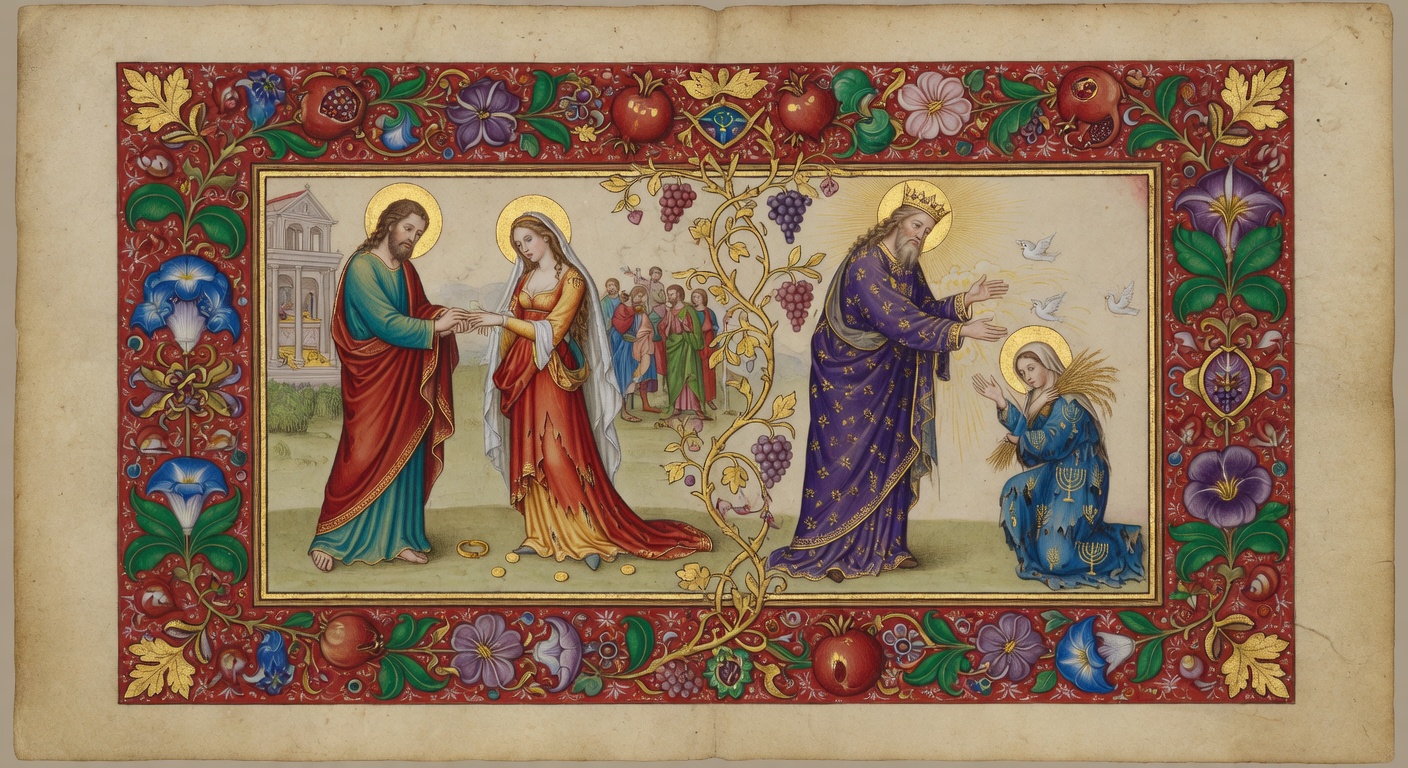
 1ear ye this, O priests; and hearken, ye house of Israel; and give ye ear, O house of the king; for judgment is toward you, because ye have been a snare on Mizpah, and a net spread upon Tabor.
2 And the revolters are profound to make slaughter, though I have been a rebuker of them all.
3 I know Ephraim, and Israel is not hid from me: for now, O Ephraim, thou committest whoredom, and Israel is defiled.
4 They will not frame their doings to turn unto their God: for the spirit of whoredoms is in the midst of them, and they have not known the LORD.
5 And the pride of Israel doth testify to his face: therefore shall Israel and Ephraim fall in their iniquity; Judah also shall fall with them.
6 They shall go with their flocks and with their herds to seek the LORD; but they shall not find him; he hath withdrawn himself from them.
7 They have dealt treacherously against the LORD: for they have begotten strange children: now shall a month devour them with their portions.
8 Blow ye the cornet in Gibeah, and the trumpet in Ramah: cry aloud at Bethaven, after thee, O Benjamin.
9 Ephraim shall be desolate in the day of rebuke: among the tribes of Israel have I made known that which shall surely be.
10 The princes of Judah were like them that remove the bound: therefore I will pour out my wrath upon them like water.
11 Ephraim is oppressed and broken in judgment, because he willingly walked after the commandment.
12 Therefore will I be unto Ephraim as a moth, and to the house of Judah as rottenness.
13 When Ephraim saw his sickness, and Judah saw his wound, then went Ephraim to the Assyrian, and sent to king Jareb: yet could he not heal you, nor cure you of your wound.
14 For I will be unto Ephraim as a lion, and as a young lion to the house of Judah: I, even I, will tear and go away; I will take away, and none shall rescue him.
15 I will go and return to my place, till they acknowledge their offence, and seek my face: in their affliction they will seek me early.
← → arrow keys to navigate chapters · spacebar to play/pause audio
Did You Know?
The chapter frames divine judgment as a deliberate two-stage process: God first acts as an internal corrosive force (moth to Ephraim, rottenness to Judah) before shifting to an external predator (lion), illustrating how covenant breach activates both hidden decay and visible conquest.
Mizpah and Tabor are named as literal hunting grounds where priests and the royal house have laid spiritual snares, likely alluding to their roles as ancient cultic or assembly sites that had become centers of syncretistic worship rather than covenant fidelity.
Ephraim's futile embassy to Assyria is presented as unwitting cooperation with the very instrument God has chosen for judgment, revealing the prophetic theme that foreign alliances cannot circumvent divine sovereignty over history.
The phrase 'strange children' points to offspring produced through ritual prostitution or intermarriage with Canaanite cults, extending the marriage metaphor so that generational impurity itself becomes grounds for the 'month' (new moon festival) consuming their allotted portions.
Verse 15's announcement of temporary divine withdrawal until Israel 'acknowledges its offense' introduces a rare explicit statement of educative intent behind judgment, linking Hosea to later Deuteronomic and penitential traditions that treat national suffering as a designed path to restored seeking.
Hosea, the only writing prophet from Israel's northern kingdom, directed his oracles primarily against the house of Jehu during the chaotic final decades before Assyria's conquest of Samaria in 722 BC.
This account illustrates Scripture’s emphasis on the extension of salvation beyond Jewish boundaries and Jesus’ willingness to cross social barriers to reveal truth.
The Nile River was worshipped as a god. Making the plague of blood a direct challenge to Egyptian religion.
Commentary & Study Notes Jamieson-Fausset-Brown (1871) · Public Domain the king — probably Pekah; the contemporary of Ahaz, king of Judah, under whom idolatry was first carried so far in Judah as to call for the judgment of the joint Syrian and Israel…
Classic verse-by-verse commentary on Hosea 5 from Jamieson, Fausset & Brown (1871). Covers: God's judgments on the priests, people, and princes of Israel for their sins.
- 1
- the king — probably Pekah; the contemporary of Ahaz, king of Judah, under whom idolatry was first carried so far in Judah as to call for the judgment of the joint Syrian and Israelite invasion, as also that of Assyria. judgment is towards you — that is, threatens you from God. ye have been a snare on Mizpah... net... upon Tabor — As hunters spread their net and snares on the hills, Mizpah and Tabor, so ye have snared the people into idolatry and made them your prey by injustice. As Mizpah and Tabor mean a "watch tower," and a "lofty place," a fit scene for hunters, playing on the words, the prophet implies, in the lofty place in which I have set you, whereas ye ought to have been the watchers of the people, guarding them from evil, ye have been as hunters entrapping them into it [JEROME]. These two places are specified, Mizpah in the east and Tabor in the west, to include the high places throughout the whole kingdom, in which Israel's rulers set up idolatrous altars.
- 2
- revolters — apostates. profound — deeply rooted [CALVIN] and sunk to the lowest depths, excessive in their idolatry (Ho 9:9; Isa 31:6) [HENDERSON]. From the antithesis (Ho 5:3), "not hid from me," I prefer explaining, profoundly cunning in their idolatry. Jeroboam thought it a profound piece of policy to set up golden calves to represent God in Dan and Beth-el, in order to prevent Israel's heart from turning again to David's line by going up to Jerusalem to worship. So Israel's subsequent idolatry was grounded by their leaders on various pleas of state expediency (compare Isa 29:15). to... slaughter — He does not say "to sacrifice," for their so-called sacrifices were butcheries rather than sacrifices; there was nothing sacred about them, being to idols instead of to the holy God. though — MAURER translates, "and (in spite of their hope of safety through their slaughter of victims to idols) I will be a chastisement to them all." English Version is good sense: They have deeply revolted, notwithstanding all my prophetical warnings.
Read all 15 notes on Hosea 5 →