Jeremiah 27 KJV
Submit to Babylon
Submit to Babylon
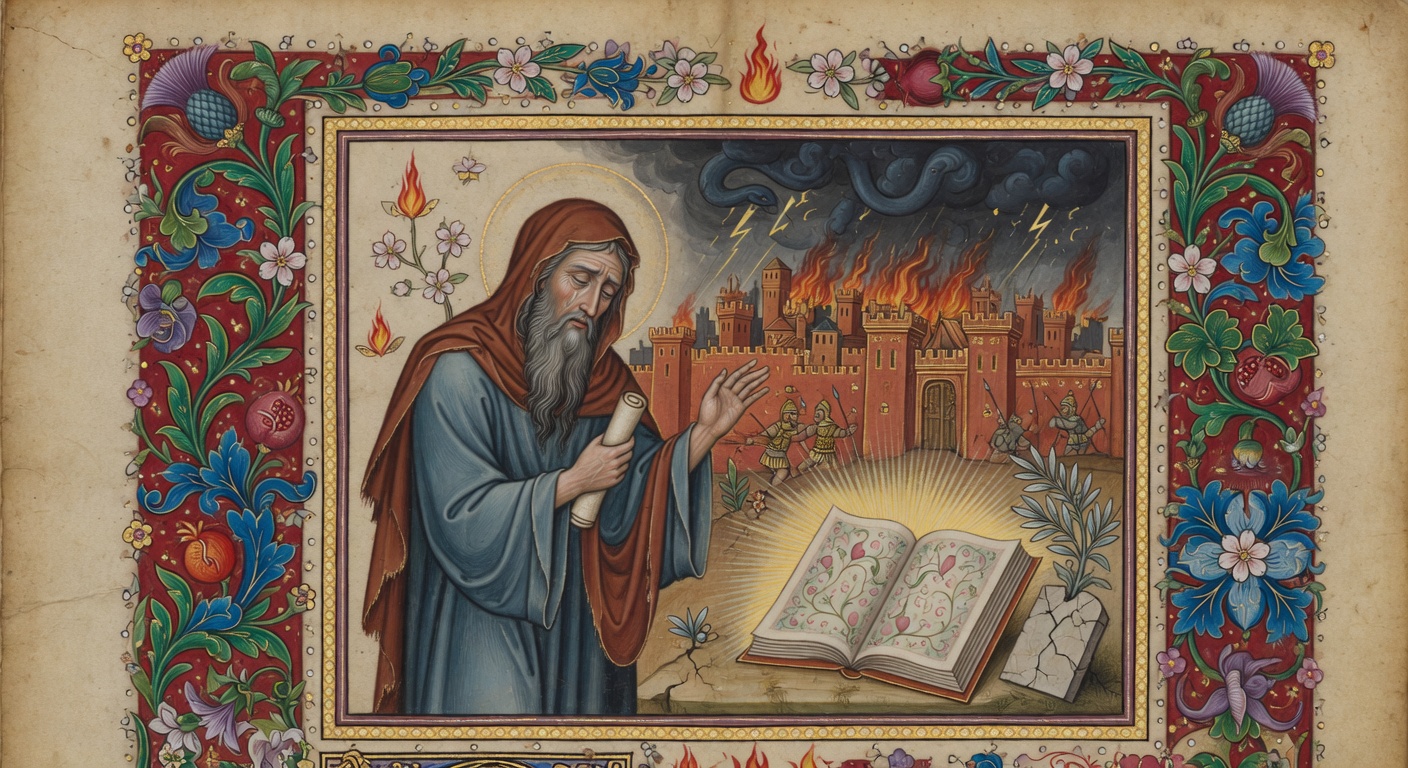
Jeremiah designates the pagan conqueror Nebuchadnezzar as God's 'servant,' a title elsewhere reserved for covenant figures like David or the prophets, underscoring that divine sovereignty can operate through an unwitting Gentile instrument.
 1n the beginning of the reign of Jehoiakim the son of Josiah king of Judah came this word unto Jeremiah from the LORD, saying,
2 Thus saith the LORD to me; Make thee bonds and yokes, and put them upon thy neck,
3 And send them to the king of Edom, and to the king of Moab, and to the king of the Ammonites, and to the king of Tyrus, and to the king of Zidon, by the hand of the messengers which come to Jerusalem unto Zedekiah king of Judah;
4 And command them to say unto their masters, Thus saith the LORD of hosts, the God of Israel; Thus shall ye say unto your masters;
5 I have made the earth, the man and the beast that are upon the ground, by my great power and by my outstretched arm, and have given it unto whom it seemed meet unto me.
6 And now have I given all these lands into the hand of Nebuchadnezzar the king of Babylon, my servant; and the beasts of the field have I given him also to serve him.
7 And all nations shall serve him, and his son, and his son’s son, until the very time of his land come: and then many nations and great kings shall serve themselves of him.
8 And it shall come to pass, that the nation and kingdom which will not serve the same Nebuchadnezzar the king of Babylon, and that will not put their neck under the yoke of the king of Babylon, that nation will I punish, saith the LORD, with the sword, and with the famine, and with the pestilence, until I have consumed them by his hand.
9 Therefore hearken not ye to your prophets, nor to your diviners, nor to your dreamers, nor to your enchanters, nor to your sorcerers, which speak unto you, saying, Ye shall not serve the king of Babylon:
10 For they prophesy a lie unto you, to remove you far from your land; and that I should drive you out, and ye should perish.
11 But the nations that bring their neck under the yoke of the king of Babylon, and serve him, those will I let remain still in their own land, saith the LORD; and they shall till it, and dwell therein.
12 I spake also to Zedekiah king of Judah according to all these words, saying, Bring your necks under the yoke of the king of Babylon, and serve him and his people, and live.
13 Why will ye die, thou and thy people, by the sword, by the famine, and by the pestilence, as the LORD hath spoken against the nation that will not serve the king of Babylon?
14 Therefore hearken not unto the words of the prophets that speak unto you, saying, Ye shall not serve the king of Babylon: for they prophesy a lie unto you.
15 For I have not sent them, saith the LORD, yet they prophesy a lie in my name; that I might drive you out, and that ye might perish, ye, and the prophets that prophesy unto you.
16 Also I spake to the priests and to all this people, saying, Thus saith the LORD; Hearken not to the words of your prophets that prophesy unto you, saying, Behold, the vessels of the LORD’s house shall now shortly be brought again from Babylon: for they prophesy a lie unto you.
17 Hearken not unto them; serve the king of Babylon, and live: wherefore should this city be laid waste?
18 But if they be prophets, and if the word of the LORD be with them, let them now make intercession to the LORD of hosts, that the vessels which are left in the house of the LORD, and in the house of the king of Judah, and at Jerusalem, go not to Babylon.
19 For thus saith the LORD of hosts concerning the pillars, and concerning the sea, and concerning the bases, and concerning the residue of the vessels that remain in this city,
20 Which Nebuchadnezzar king of Babylon took not, when he carried away captive Jeconiah the son of Jehoiakim king of Judah from Jerusalem to Babylon, and all the nobles of Judah and Jerusalem;
21 Yea, thus saith the LORD of hosts, the God of Israel, concerning the vessels that remain in the house of the LORD, and in the house of the king of Judah and of Jerusalem;
22 They shall be carried to Babylon, and there shall they be until the day that I visit them, saith the LORD; then will I bring them up, and restore them to this place.
← → arrow keys to navigate chapters · spacebar to play/pause audio
Did You Know?
Jeremiah designates the pagan conqueror Nebuchadnezzar as God's 'servant,' a title elsewhere reserved for covenant figures like David or the prophets, underscoring that divine sovereignty can operate through an unwitting Gentile instrument.
The chapter depicts an actual diplomatic summit in Jerusalem where envoys from Edom, Moab, Ammon, Tyre, and Sidon receive identical instructions to return home and counsel their kings to accept Babylonian vassalage, revealing coordinated regional resistance that Jeremiah seeks to dismantle.
By placing yokes on his own neck before delivering the oracle, Jeremiah enacts a sign-act that extends the symbol of servitude beyond Judah to the surrounding nations, transforming a local political crisis into a cosmic declaration of Yahweh's control over all lands.
The text specifically forecasts that the temple vessels will be carried to Babylon yet returned 'in the day that I visit them,' a detail that both explains their historical removal and plants a seed of future restoration amid apparent permanent loss.
Jeremiah equates heeding diviners, dreamers, and soothsayers with rebellion against Yahweh, thereby framing political miscalculation as theological infidelity and positioning true prophecy as the sole reliable guide amid competing oracles of swift deliverance.
King Jehoiakim personally cut and burned Jeremiah’s scroll of prophecies column by column in his winter palace fireplace, prompting the prophet to dictate an expanded second edition that included a specific curse against the king.
After King Jehoiakim burned the first scroll of Jeremiah's prophecies in 604 BC, Baruch produced a second edition that added many similar words, demonstrating the fluid expansion of prophetic literature during the late monarchy.
The Babylonian Chronicles corroborate the biblical account of Nebuchadnezzar's 597 BC siege of Jerusalem, during which he deported King Jehoiachin and installed Zedekiah, marking the first major wave of exile.
Gedaliah set up his administration at Mizpah rather than the ruined Jerusalem, where he urged the surviving Judeans to submit to Babylonian rule and resume agricultural life, briefly restoring a measure of normalcy in 586 BCE.
Three major world religions consider Jerusalem a holy city.
The Hanging Gardens of Babylon were one of the Seven Wonders of the Ancient World.
The Israelites lived in Egypt for approximately 430 years.
Commentary & Study Notes Jamieson-Fausset-Brown (1871) · Public Domain Jehoiakim — The prophecy that follows was according to this reading given in the fourth year of Jehoiakim, fifteen years before it was published in the reign of Zedekiah to whom it…
Classic verse-by-verse commentary on Jeremiah 27 from Jamieson, Fausset & Brown (1871). Covers: The futility of resisting nebuchadnezzar illustrated to the ambassadors of the kings, desiring to have the king of Judah confederate with them, under the type of yokes. Jeremiah exhorts them and zedekiah to yield.
- 1
- Jehoiakim — The prophecy that follows was according to this reading given in the fourth year of Jehoiakim, fifteen years before it was published in the reign of Zedekiah to whom it refers; it was thus long deposited in the prophet's bosom, in order that by it he might be supported under trials in his prophetic career in the interim [CALVIN]. But "Zedekiah" may be the true reading. So the Syriac and Arabic Versions. Jer 27:3, 12; Jer 28:1, confirm this; also, one of KENNICOTT'S manuscripts. The English Version reading may have originated from Jer 26:1. "Son of Josiah" applies to Zedekiah as truly as to "Jehoiakim" or "Eliakim." The fourth year may, in a general sense here, as in Jer 28:1, be called "the beginning of his reign," as it lasted eleven years (2Ki 24:18). It was not long after the fourth year of his reign that he rebelled against Nebuchadnezzar (Jer 51:59; 52:3; 2Ki 24:20), in violation of an oath before God (2Ch 36:13).
- 2
- bonds — by which the yoke is made fast to the neck (Jer 5:5). yokes — literally, the carved piece of wood attached at both ends to the two yokes on the necks of a pair of oxen, so as to connect them. Here the yoke itself. The plural is used, as he was to wear one himself, and give the others to the ambassadors; (Jer 27:3; 28:10, 12) proves that the symbolical act was in this instance (though not in others, Jer 25:15) actually done (compare Isa 20:2, &c.; Eze 12:3, 11, 18).
Read all 18 notes on Jeremiah 27 →