Jeremiah 45 KJV
A Message to Baruch
A Message to Baruch
This chapter is set in 605 BC during the fourth year of Jehoiakim, the precise moment Baruch first inscribed Jeremiah's scroll that the king would later burn, positioning Baruch as the human agent preserving the prophetic word through political upheaval.
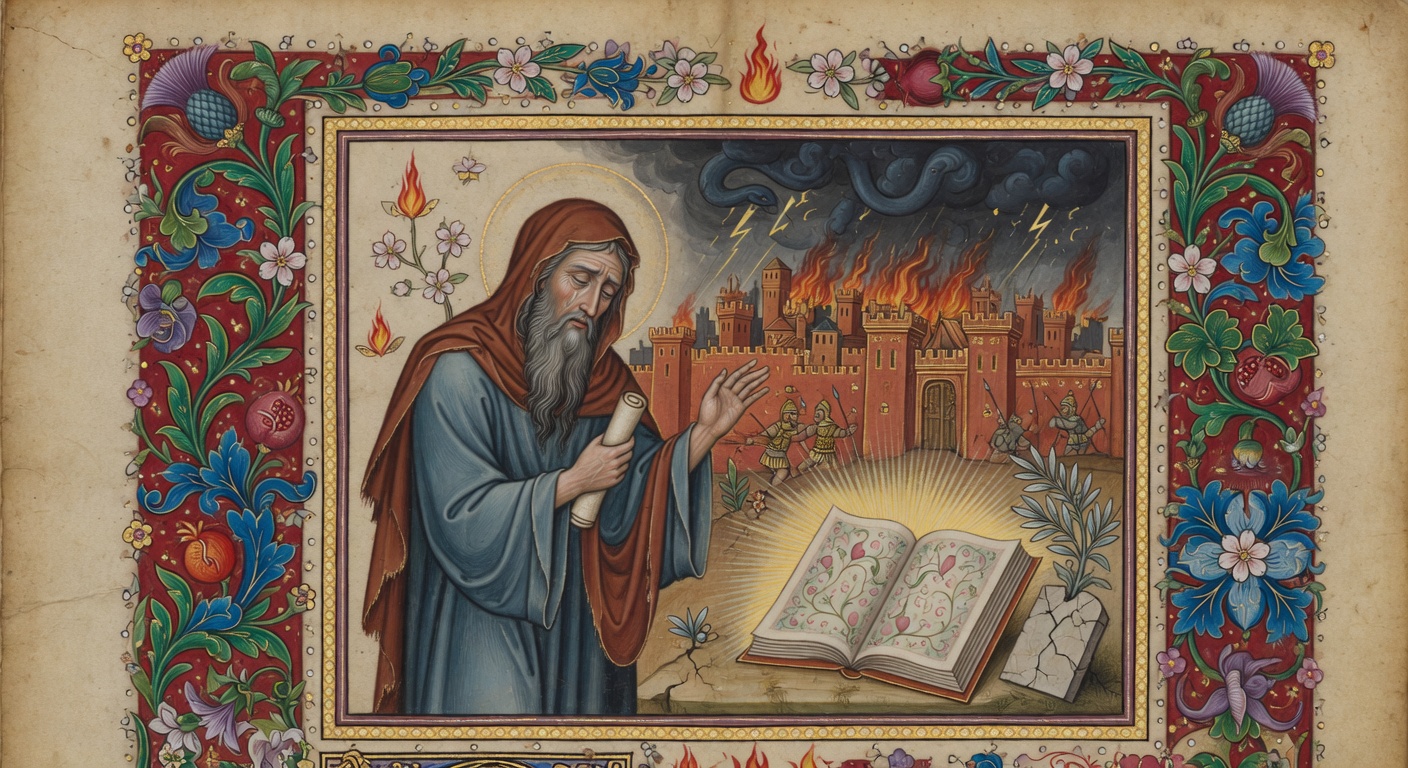
 1he word that Jeremiah the prophet spake unto Baruch the son of Neriah, when he had written these words in a book at the mouth of Jeremiah, in the fourth year of Jehoiakim the son of Josiah king of Judah, saying,
2 Thus saith the LORD, the God of Israel, unto thee, O Baruch:
3 Thou didst say, Woe is me now! for the LORD hath added grief to my sorrow; I fainted in my sighing, and I find no rest.
4 Thus shalt thou say unto him, The LORD saith thus; Behold, that which I have built will I break down, and that which I have planted I will pluck up, even this whole land.
5 And seekest thou great things for thyself? seek them not: for, behold, I will bring evil upon all flesh, saith the LORD: but thy life will I give unto thee for a prey in all places whither thou goest.
← → arrow keys to navigate chapters · spacebar to play/pause audio
Did You Know?
This chapter is set in 605 BC during the fourth year of Jehoiakim, the precise moment Baruch first inscribed Jeremiah's scroll that the king would later burn, positioning Baruch as the human agent preserving the prophetic word through political upheaval.
Baruch's complaint about added grief and lost rest deliberately echoes Jeremiah's own laments in chapters 15 and 20, revealing that the scribe internalized the same prophetic anguish rather than serving as a detached recorder.
The assurance that Baruch's life would be given 'for a prey' uses identical phrasing to the promise made to Ebed-melech in chapter 39, establishing a recurring motif of divine protection extended to individuals who aid Jeremiah amid national judgment.
Baruch is warned against seeking 'great things,' an admonition that likely addresses his possible aristocratic lineage as son of Neriah and brother to Seraiah, the royal quartermaster mentioned in 51:59, hinting at suppressed ambitions for status or influence.
Placed immediately before the oracles against foreign nations, the chapter functions as a personal counterpoint to cosmic-scale judgment, underscoring that God's care extends to the survival of one faithful servant even while empires fall.
Jeremiah was forbidden by God from marrying or having children, a living sign that the coming Babylonian invasion would bring death and exile to entire families across Judah.
Baruch belonged to a prominent scribal family; his brother Seraiah served as King Zedekiah's quartermaster and carried a scroll of Jeremiah's oracles to Babylon in 593 BC.
In the Book of Daniel, Nebuchadnezzar erected a 90-foot golden statue on the plain of Dura and required all officials to worship it, an event that led to the fiery furnace ordeal for Daniel's companions and his subsequent decree protecting their God.
Gedaliah was the grandson of Shaphan, the royal scribe who discovered the Book of the Law during Josiah's temple renovations, connecting him directly to the last major religious reform before the exile.
The city has been destroyed at least twice, besieged 23 times, and captured 44 times.
The Hanging Gardens of Babylon were one of the Seven Wonders of the Ancient World.
The Israelites lived in Egypt for approximately 430 years.
Commentary & Study Notes Jamieson-Fausset-Brown (1871) · Public Domain these words — his prophecies from the thirteenth year of Josiah to the fourth of Jehoiakim.
Classic verse-by-verse commentary on Jeremiah 45 from Jamieson, Fausset & Brown (1871). Covers: Jeremiah comforts baruch.
- 1
- these words — his prophecies from the thirteenth year of Josiah to the fourth of Jehoiakim.
- 3
- Thou didst say, &c. — Jeremiah does not spare his disciple, but unveils his fault, namely, fear for his life by reason of the suspicions which he incurred in the eyes of his countrymen (compare Jer 36:17), as if he was in sympathy with the Chaldeans (Jer 43:3), and instigator of Jeremiah; also ingratitude in speaking of his "grief," &c., whereas he ought to deem himself highly blessed in being employed by God to record Jeremiah's prophecies. added — rescued from the peril of my first writing (Jer 36:26). I am again involved in a similar peril. He upbraids God as dealing harshly with him. I fainted — rather, "I am weary." no rest — no quiet resting-place.
Read all 4 notes on Jeremiah 45 →