Matthew 3 KJV
John the Baptist
Echoes & Connections 3 connections
John the Baptist
John's camel-hair garment and leather belt deliberately echo Elijah's description in 2 Kings 1:8, invoking Malachi 4:5 to cast the Baptist as the eschatological forerunner whose ministry ignites the 'great and dreadful day of the Lord.'
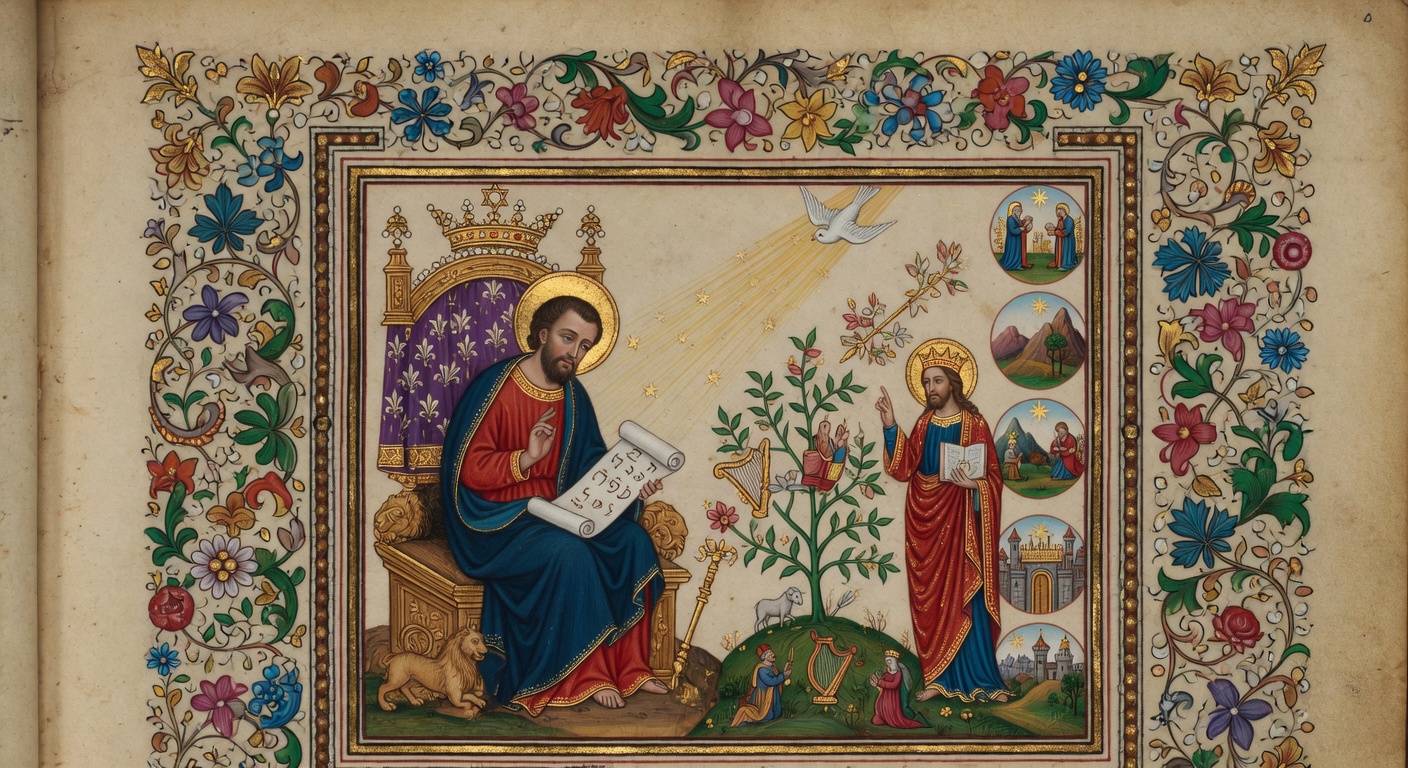
 1n those days came John the Baptist, preaching in the wilderness of Judaea,
2 And saying, Repent ye: for the kingdom of heaven is at hand.
3 For this is he that was spoken of by the prophet Esaias, saying, The voice of one crying in the wilderness, Prepare ye the way of the Lord, make his paths straight.
4 And the same John had his raiment of camel’s hair, and a leathern girdle about his loins; and his meat was locusts and wild honey.
5 Then went out to him Jerusalem, and all Judaea, and all the region round about Jordan,
6 And were baptized of him in Jordan, confessing their sins.
7 But when he saw many of the Pharisees and Sadducees come to his baptism, he said unto them, O generation of vipers, who hath warned you to flee from the wrath to come?
8 Bring forth therefore fruits meet for repentance:
9 And think not to say within yourselves, We have Abraham to our father: for I say unto you, that God is able of these stones to raise up children unto Abraham.
10 And now also the axe is laid unto the root of the trees: therefore every tree which bringeth not forth good fruit is hewn down, and cast into the fire.
11 I indeed baptize you with water unto repentance: but he that cometh after me is mightier than I, whose shoes I am not worthy to bear: he shall baptize you with the Holy Ghost, and with fire:
12 Whose fan is in his hand, and he will throughly purge his floor, and gather his wheat into the garner; but he will burn up the chaff with unquenchable fire.
13 Then cometh Jesus from Galilee to Jordan unto John, to be baptized of him.
14 But John forbad him, saying, I have need to be baptized of thee, and comest thou to me?
15 And Jesus answering said unto him, Suffer it to be so now: for thus it becometh us to fulfil all righteousness. Then he suffered him.
16 And Jesus, when he was baptized, went up straightway out of the water: and, lo, the heavens were opened unto him, and he saw the Spirit of God descending like a dove, and lighting upon him:
17 And lo a voice from heaven, saying, This is my beloved Son, in whom I am well pleased.
← → arrow keys to navigate chapters · spacebar to play/pause audio
Did You Know?
John's camel-hair garment and leather belt deliberately echo Elijah's description in 2 Kings 1:8, invoking Malachi 4:5 to cast the Baptist as the eschatological forerunner whose ministry ignites the 'great and dreadful day of the Lord.'
The Jordan baptism site evokes Joshua's crossing into Canaan (Joshua 3), reframing entry into the promised land as spiritual passage through repentance and Spirit-anointing rather than military conquest.
Jesus' insistence on baptism 'to fulfil all righteousness' (3:15) uses the Matthean term 'plēroō' to signal prophetic completion, portraying his submersion as the pivotal act that inaugurates the new covenant's righteous requirements for Israel and the nations.
The Spirit's descent 'like a dove' alludes to the hovering Spirit over primordial waters (Genesis 1:2) and Noah's dove (Genesis 8:8-12), marking Jesus' baptism as the onset of new creation amid judgment waters.
Calling Pharisees and Sadducees a 'generation of vipers' fuses Genesis 3 serpent imagery with Isaiah 59:5, indicting religious hypocrisy as venomous offspring whose Abrahamic claims cannot avert the axe already laid to Israel's root.
John's execution by beheading was prompted by a dance performed by Herodias's daughter at Herod's birthday banquet, leading to a rash oath that the king felt compelled to honor (Mark 6:21-28).
Jesus appeared to over five hundred people at one time after his resurrection, a mass sighting noted by Paul in 1 Corinthians 15 that provides early corroboration beyond the Gospel accounts.
In Acts, the sick were laid in Jerusalem's streets hoping Peter's passing shadow would heal them, reflecting the extraordinary perception of his apostolic authority among early believers.
While standing at the foot of the cross, Jesus entrusted Mary's care to the disciple John rather than to his own brothers, implying that his siblings were not yet followers and underscoring the early Christian community's shift from biological to spiritual family ties.
The Jordan River drops over 3,000 feet from its source to the Dead Sea.
Three major world religions consider Jerusalem a holy city.
Bethlehem means 'House of Bread' in Hebrew. Fitting for the birthplace of the 'Bread of Life'.
Commentary & Study Notes Jamieson-Fausset-Brown (1871) · Public Domain Here, as BENGEL well observes, the curtain of the New Testament is, as it were, drawn up, and the greatest of all epochs of the Church commences. Even our Lord's own age is determi…
Classic verse-by-verse commentary on Matthew 3 from Jamieson, Fausset & Brown (1871). Covers: Preaching and ministry of john. ( = mr 1:1-8; Lu 3:1-18); Baptism of Christ and descent of the spirit upon him immediately thereafter. ( = mr 1:9-11; Lu 3:21, 22; Joh 1:31-34).
- 2
- Here, as BENGEL well observes, the curtain of the New Testament is, as it were, drawn up, and the greatest of all epochs of the Church commences. Even our Lord's own age is determined by it (Lu 3:23). No such elaborate chronological precision is to be found elsewhere in the New Testament, and it comes fitly from him who claims it as the peculiar recommendation of his Gospel, that "he had traced down all things with precision from the very first" (Mt 1:3). Here evidently commences his proper narrative. Lu 3:1: Now in the fifteenth year of the reign of Tiberius Cæsar — not the fifteenth from his full accession on the death of Augustus, but from the period when he was associated with him in the government of the empire, three years earlier, about the end of the year of Rome 779, or about four years before the usual reckoning. Pontius Pilate being governor of Judea — His proper title was procurator, but with more than the usual powers of that office. After holding it for about ten years, he was summoned to Rome to answer to charges brought against him; but ere he arrived, Tiberius died (A.D. 35), and soon after miserable Pilate committed suicide. And Herod being tetrarch of Galilee — (See on Mr 6:14). and his brother Philip — a very different and very superior Philip to the one whose name was Herod Philip, and whose wife, Herodias, went to live with Herod Antipas (see on Mr 6:17). tetrarch of Ituræa — lying to the northeast of Palestine, and so called from Itur or Jetur, Ishmael's son (1Ch 1:31), and anciently belonging to the half-tribe of Manasseh. and of the region of Trachonitis — lying farther to the northeast, between Iturea and Damascus; a rocky district infested by robbers, and committed by Augustus to Herod the Great to keep in order. and Lysanias the tetrarch of Abilene — still more to the northeast; so called, says ROBINSON, from Abila, eighteen miles from Damascus. Lu 3:2: Annas and Caiaphas being the high priests — The former, though deposed, retained much of his influence, and, probably, as sagan or deputy, exercised much of the power of the high priesthood along with Caiaphas, his son-in-law (Joh 18:13; Ac 4:6). In David's time both Zadok and Abiathar acted as high priests (2Sa 15:35), and it seems to have been the fixed practice to have two (2Ki 25:18). the word of God came unto John the son of Zacharias in the wilderness — Such a way of speaking is never once used when speaking of Jesus, because He was Himself The Living Word; whereas to all merely creature-messengers of God, the word they spoke was a foreign element. See on Joh 3:31. We are now prepared for the opening words of Matthew.
- 1
- In those days — of Christ's secluded life at Nazareth, where the last chapter left Him. came John the Baptist, preaching — about six months before his Master. in the wilderness of Judea — the desert valley of the Jordan, thinly peopled and bare in pasture, a little north of Jerusalem.
Read all 19 notes on Matthew 3 →