Numbers 25 KJV
Moab Seduces Israel
Moab Seduces Israel
Phinehas's spear thrust through Zimri and Cozbi atones for the corporate sin in a single act of zeal, securing an everlasting covenant of peace and priesthood that parallels the Abrahamic promise of perpetual offspring yet is conditioned on violent fidelity rather than mere descent.
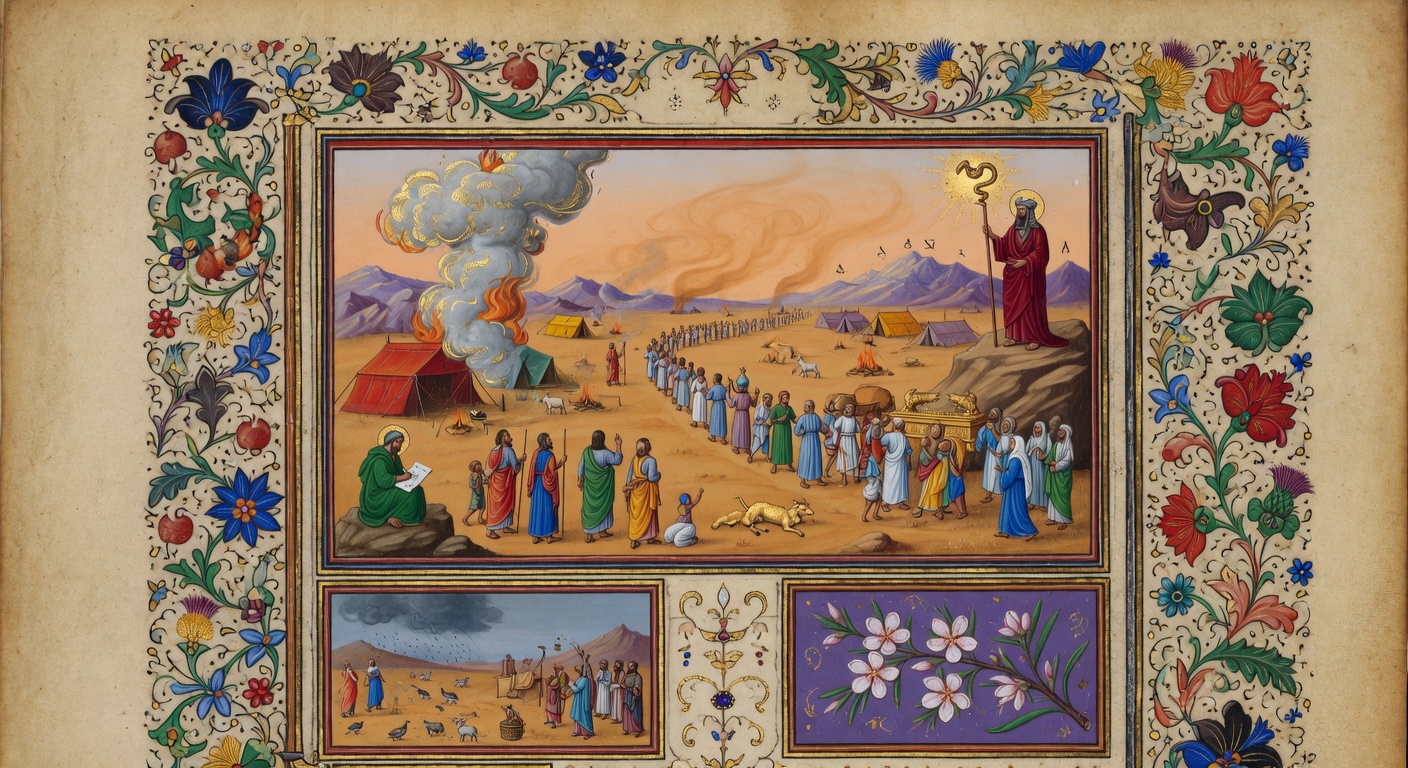
 1nd Israel abode in Shittim, and the people began to commit whoredom with the daughters of Moab.
2 And they called the people unto the sacrifices of their gods: and the people did eat, and bowed down to their gods.
3 And Israel joined himself unto Baalpeor: and the anger of the LORD was kindled against Israel.
4 And the LORD said unto Moses, Take all the heads of the people, and hang them up before the LORD against the sun, that the fierce anger of the LORD may be turned away from Israel.
5 And Moses said unto the judges of Israel, Slay ye every one his men that were joined unto Baalpeor.
6 And, behold, one of the children of Israel came and brought unto his brethren a Midianitish woman in the sight of Moses, and in the sight of all the congregation of the children of Israel, who were weeping before the door of the tabernacle of the congregation.
7 And when Phinehas, the son of Eleazar, the son of Aaron the priest, saw it, he rose up from among the congregation, and took a javelin in his hand;
8 And he went after the man of Israel into the tent, and thrust both of them through, the man of Israel, and the woman through her belly. So the plague was stayed from the children of Israel.
9 And those that died in the plague were twenty and four thousand.
10 And the LORD spake unto Moses, saying,
11 Phinehas, the son of Eleazar, the son of Aaron the priest, hath turned my wrath away from the children of Israel, while he was zealous for my sake among them, that I consumed not the children of Israel in my jealousy.
12 Wherefore say, Behold, I give unto him my covenant of peace:
13 And he shall have it, and his seed after him, even the covenant of an everlasting priesthood; because he was zealous for his God, and made an atonement for the children of Israel.
14 Now the name of the Israelite that was slain, even that was slain with the Midianitish woman, was Zimri, the son of Salu, a prince of a chief house among the Simeonites.
15 And the name of the Midianitish woman that was slain was Cozbi, the daughter of Zur; he was head over a people, and of a chief house in Midian.
16 And the LORD spake unto Moses, saying,
17 Vex the Midianites, and smite them:
18 For they vex you with their wiles, wherewith they have beguiled you in the matter of Peor, and in the matter of Cozbi, the daughter of a prince of Midian, their sister, which was slain in the day of the plague for Peor’s sake.
← → arrow keys to navigate chapters · spacebar to play/pause audio
Did You Know?
Phinehas's spear thrust through Zimri and Cozbi atones for the corporate sin in a single act of zeal, securing an everlasting covenant of peace and priesthood that parallels the Abrahamic promise of perpetual offspring yet is conditioned on violent fidelity rather than mere descent.
Although the chapter opens with Moabite women, the slain Cozbi is explicitly a Midianite princess whose father Zur appears in the Midianite genealogy of Numbers 31, exposing the Moab-Midian alliance and foreshadowing the retaliatory holy war commanded immediately afterward.
Balaam's oracles of blessing in chapters 22-24 are subverted by his later counsel (revealed in 31:16) that turned Israel toward Baal-peor, demonstrating how prophetic speech can coexist with malevolent strategy that achieves what direct cursing could not.
The plague halts precisely when Phinehas acts inside the tent, not at the tabernacle, underscoring a theology in which intercession occurs through embodied confrontation rather than solely through altar sacrifice or Mosaic mediation.
Shittim, the site of this apostasy, is the identical location from which Joshua dispatches the two spies in Joshua 2:1, framing the wilderness generation's final failure as the threshold to conquest and highlighting the narrative pivot from rebellion to inheritance.
Phinehas bore an Egyptian-derived name meaning "the Nubian," highlighting possible cultural influences on Aaron's family from their generations in Egypt before the Exodus.
Although the Bible explains Moses' name through a Hebrew etymology as "drawn out" of the water, it closely matches the Egyptian term for "son" found in royal names like Thutmose, reflecting his adoption into Pharaoh's household during the New Kingdom period.
Aaron's budding rod was not only a sign during Korah's rebellion but was later stored in the Ark of the Covenant alongside the stone tablets and a jar of manna, serving as an enduring witness to God's choice of the Aaronic priesthood.
Miriam is the only woman explicitly titled a prophetess in the Torah, and she leads the Israelite women in a victory song accompanied by timbrels immediately after the Red Sea crossing, preserving one of the Bible's oldest poetic fragments.
From this site Moses sent twelve spies to explore the Promised Land, yet ten returned with a fearful report that sparked widespread rebellion and refusal to enter as God commanded.
This site holds profound significance in Scripture as a symbol of divine promise, human limitation, and the transition of authority to Joshua for the conquest of the land.
This land became the setting for Ruth's faithful journey to Bethlehem, through which a Moabite woman entered the line leading to David and the promised Messiah.
Commentary & Study Notes Jamieson-Fausset-Brown (1871) · Public Domain Israel abode in Shittim — a verdant meadow, so called from a grove of acacia trees which lined the eastern side of the Jordan. (See Nu 33:49).
Classic verse-by-verse commentary on Numbers 25 from Jamieson, Fausset & Brown (1871). Covers: The israelites' whoredom and idolatry with moab.
- 1
- Israel abode in Shittim — a verdant meadow, so called from a grove of acacia trees which lined the eastern side of the Jordan. (See Nu 33:49).
- 3
- Israel joined himself unto Baal-peor — Baal was a general name for "lord," and Peor for a "mount" in Moab. The real name of the idol was Chemosh, and his rites of worship were celebrated by the grossest obscenity. In participating in this festival, then, the Israelites committed the double offense of idolatry and licentiousness.
Read all 11 notes on Numbers 25 →