Romans 10 KJV
Salvation for All Who Believe
Echoes & Connections 1 connections
Salvation for All Who Believe
Paul's quotation of Deuteronomy 30:12-14 in verses 6-8 deliberately transfers Moses' description of the law's accessibility to the person of Christ, creating a typological reversal where the 'word' now refers to the preached gospel rather than Torah observance. Themes: Salvation
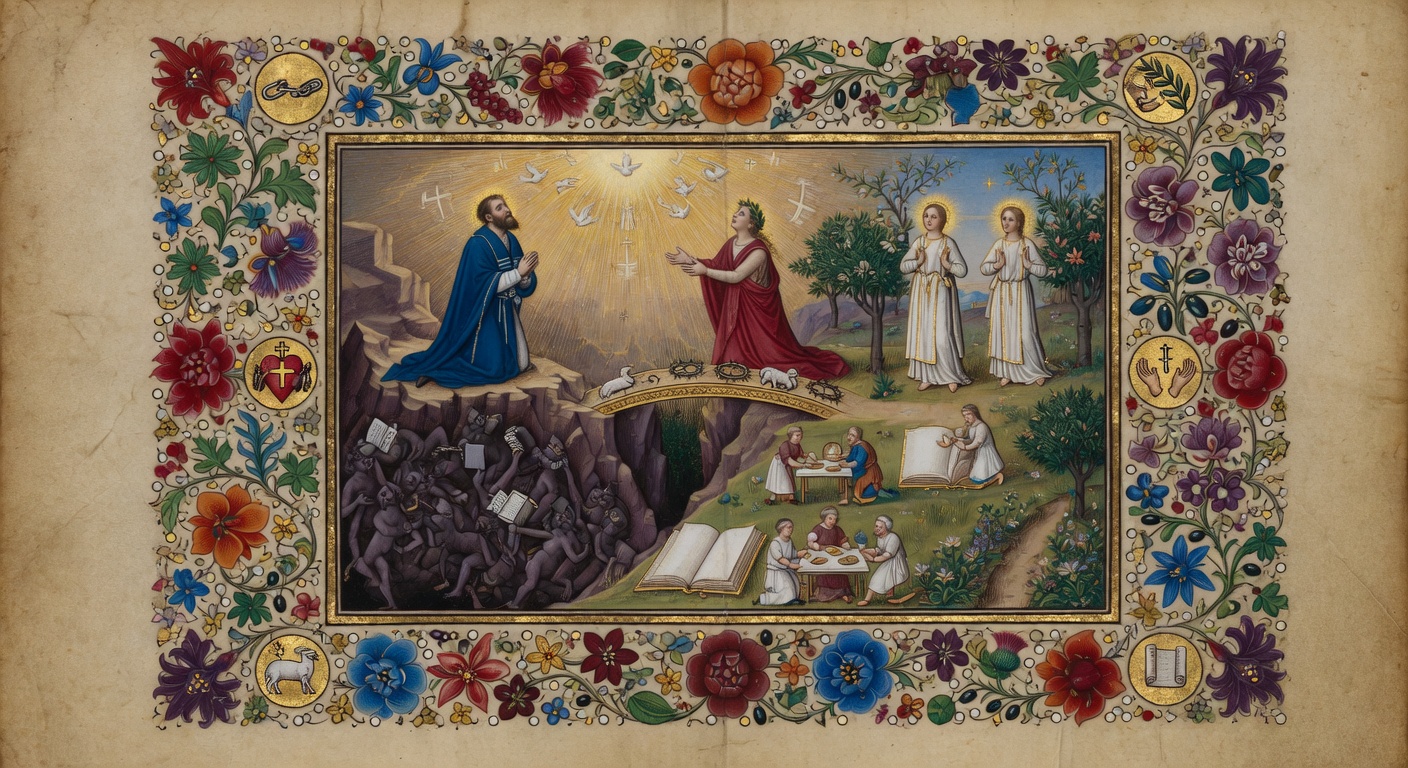
 1rethren, my heart’s desire and prayer to God for Israel is, that they might be saved.
2 For I bear them record that they have a zeal of God, but not according to knowledge.
3 For they being ignorant of God’s righteousness, and going about to establish their own righteousness, have not submitted themselves unto the righteousness of God.
4 For Christ is the end of the law for righteousness to every one that believeth.
5 For Moses describeth the righteousness which is of the law, That the man which doeth those things shall live by them.
6 But the righteousness which is of faith speaketh on this wise, Say not in thine heart, Who shall ascend into heaven? (that is, to bring Christ down from above:)
7 Or, Who shall descend into the deep? (that is, to bring up Christ again from the dead.)
8 But what saith it? The word is nigh thee, even in thy mouth, and in thy heart: that is, the word of faith, which we preach;
9 That if thou shalt confess with thy mouth the Lord Jesus, and shalt believe in thine heart that God hath raised him from the dead, thou shalt be saved.
10 For with the heart man believeth unto righteousness; and with the mouth confession is made unto salvation.
11 For the scripture saith, Whosoever believeth on him shall not be ashamed.
12 For there is no difference between the Jew and the Greek: for the same Lord over all is rich unto all that call upon him.
13 For whosoever shall call upon the name of the Lord shall be saved.
14 How then shall they call on him in whom they have not believed? and how shall they believe in him of whom they have not heard? and how shall they hear without a preacher?
15 And how shall they preach, except they be sent? as it is written, How beautiful are the feet of them that preach the gospel of peace, and bring glad tidings of good things!
16 But they have not all obeyed the gospel. For Esaias saith, Lord, who hath believed our report?
17 So then faith cometh by hearing, and hearing by the word of God.
18 But I say, Have they not heard? Yes verily, their sound went into all the earth, and their words unto the ends of the world.
19 But I say, Did not Israel know? First Moses saith, I will provoke you to jealousy by them that are no people, and by a foolish nation I will anger you.
20 But Esaias is very bold, and saith, I was found of them that sought me not; I was made manifest unto them that asked not after me.
21 But to Israel he saith, All day long I have stretched forth my hands unto a disobedient and gainsaying people.
← → arrow keys to navigate chapters · spacebar to play/pause audio
Did You Know?
Paul's quotation of Deuteronomy 30:12-14 in verses 6-8 deliberately transfers Moses' description of the law's accessibility to the person of Christ, creating a typological reversal where the 'word' now refers to the preached gospel rather than Torah observance.
The reference to 'beautiful feet' in verse 15 draws from Isaiah 52:7 but shifts the original context of heralds announcing Jerusalem's restoration after exile to the apostolic mission extending salvation to Gentiles, implying a redefinition of Israel's restoration.
Verse 9's pairing of mouth-confession and heart-belief echoes ancient Near Eastern covenant ratification formulas and may reflect the earliest Christian baptismal or credal practices, where public acknowledgment of Jesus as Lord functioned as a boundary marker of faith.
By applying Joel 2:32's invocation of the divine name YHWH to Jesus in verse 13, Paul performs an early Christological move that equates the risen Lord with the God of Israel, a reading that would have been provocative within Second Temple Jewish monotheism.
The chain of rhetorical questions in verses 14-15 mirrors Greco-Roman diatribe style while constructing a logical sequence that positions the apostolic preaching office as indispensable, subtly justifying Paul's own Gentile mission as fulfillment of prophetic necessity.
Paul's Roman citizenship, acquired through his birth in the prominent city of Tarsus, granted him the rare legal privilege to appeal directly to Caesar, which he exercised during his trial before Festus and ultimately led to his voyage to Rome.
Phoebe is the first individual Paul names in Romans 16 and receives the same Greek title diakonos he applies to himself and other male ministers, indicating she held an official leadership role in the Cenchreae congregation around AD 56.
Tradition holds that both Peter and Paul were martyred in Rome.
Commentary & Study Notes Jamieson-Fausset-Brown (1871) · Public Domain Brethren, my heart's desire — The word here expresses "entire complacency," that in which the heart would experience full satisfaction. and prayer — "supplication." to God for Isra…
Classic verse-by-verse commentary on Romans 10 from Jamieson, Fausset & Brown (1871). Covers: Same subject continued--how Israel came to miss salvation, and the gentiles to find it.
- 1
- Brethren, my heart's desire — The word here expresses "entire complacency," that in which the heart would experience full satisfaction. and prayer — "supplication." to God for Israel — "for them" is the true reading; the subject being continued from the close of the preceding chapter. is, that they may be saved — "for their salvation." Having before poured forth the anguish of his soul at the general unbelief of his nation and its dreadful consequences (Ro 9:1-3), he here expresses in the most emphatic terms his desire and prayer for their salvation.
- 2
- For I bear them record — or, "witness," as he well could from his own sad experience. that they have a zeal of — "for" God, but not according to knowledge — (Compare Ac 22:3; 26:9-11; Ga 1:13, 14). He alludes to this well-meaning of his people, notwithstanding their spiritual blindness, not certainly to excuse their rejection of Christ and rage against His saints, but as some ground of hope regarding them. (See 1Ti 1:13).
Read all 21 notes on Romans 10 →