Ruth 4 KJV
Boaz Redeems Ruth
Boaz Redeems Ruth
The sandal removal custom in verse 7 is explicitly framed as a practice 'in former time in Israel,' signaling the book's composition during or after the monarchy when this legal symbol had already become archaic.
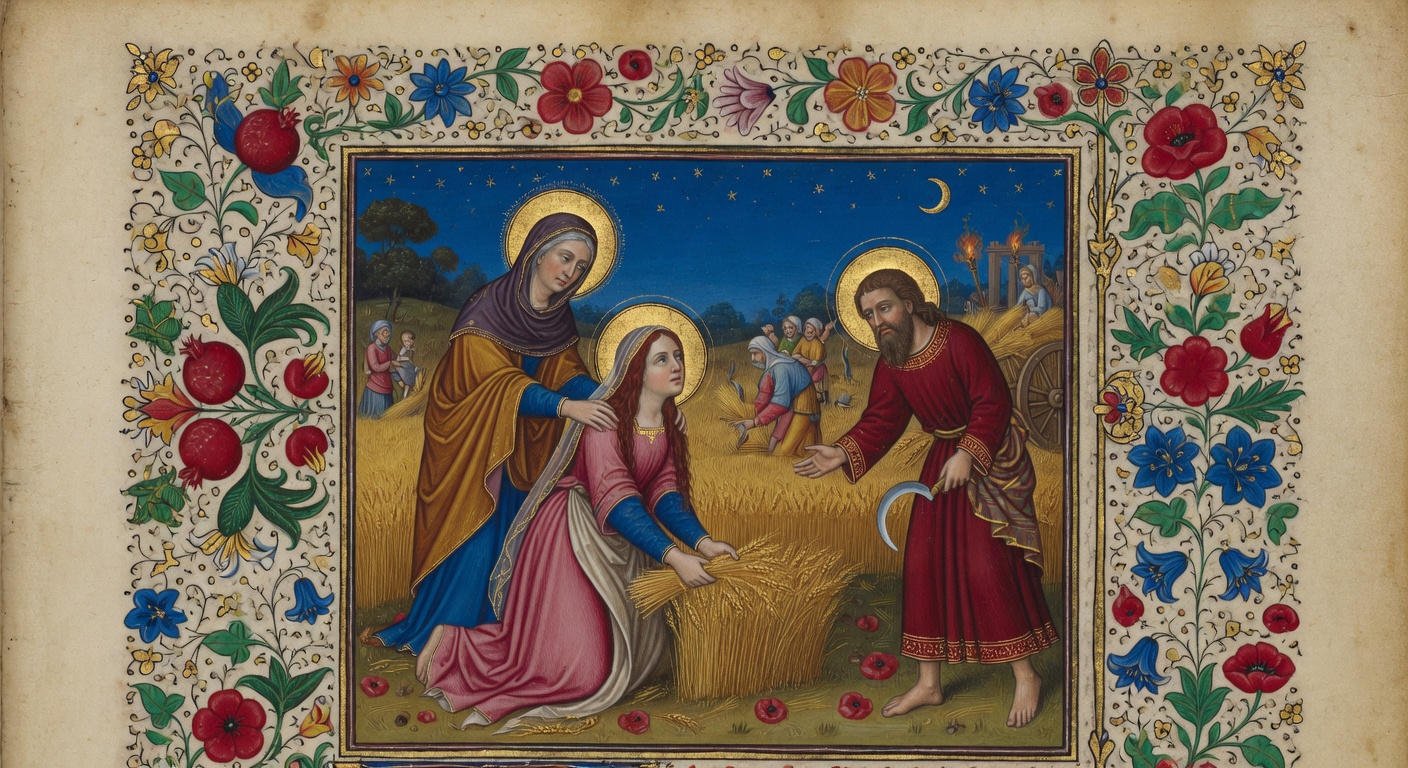
 1hen went Boaz up to the gate, and sat him down there: and, behold, the kinsman of whom Boaz spake came by; unto whom he said, Ho, such a one! turn aside, sit down here. And he turned aside, and sat down.
2 And he took ten men of the elders of the city, and said, Sit ye down here. And they sat down.
3 And he said unto the kinsman, Naomi, that is come again out of the country of Moab, selleth a parcel of land, which was our brother Elimelech’s:
4 And I thought to advertise thee, saying, Buy it before the inhabitants, and before the elders of my people. If thou wilt redeem it, redeem it: but if thou wilt not redeem it, then tell me, that I may know: for there is none to redeem it beside thee; and I am after thee. And he said, I will redeem it.
5 Then said Boaz, What day thou buyest the field of the hand of Naomi, thou must buy it also of Ruth the Moabitess, the wife of the dead, to raise up the name of the dead upon his inheritance.
6 And the kinsman said, I cannot redeem it for myself, lest I mar mine own inheritance: redeem thou my right to thyself; for I cannot redeem it.
7 Now this was the manner in former time in Israel concerning redeeming and concerning changing, for to confirm all things; a man plucked off his shoe, and gave it to his neighbour: and this was a testimony in Israel.
8 Therefore the kinsman said unto Boaz, Buy it for thee. So he drew off his shoe.
9 And Boaz said unto the elders, and unto all the people, Ye are witnesses this day, that I have bought all that was Elimelech’s, and all that was Chilion’s and Mahlon’s, of the hand of Naomi.
10 Moreover Ruth the Moabitess, the wife of Mahlon, have I purchased to be my wife, to raise up the name of the dead upon his inheritance, that the name of the dead be not cut off from among his brethren, and from the gate of his place: ye are witnesses this day.
11 And all the people that were in the gate, and the elders, said, We are witnesses. The LORD make the woman that is come into thine house like Rachel and like Leah, which two did build the house of Israel: and do thou worthily in Ephratah, and be famous in Bethlehem:
12 And let thy house be like the house of Pharez, whom Tamar bare unto Judah, of the seed which the LORD shall give thee of this young woman.
13 So Boaz took Ruth, and she was his wife: and when he went in unto her, the LORD gave her conception, and she bare a son.
14 And the women said unto Naomi, Blessed be the LORD, which hath not left thee this day without a kinsman, that his name may be famous in Israel.
15 And he shall be unto thee a restorer of thy life, and a nourisher of thine old age: for thy daughter in law, which loveth thee, which is better to thee than seven sons, hath born him.
16 And Naomi took the child, and laid it in her bosom, and became nurse unto it.
17 And the women her neighbours gave it a name, saying, There is a son born to Naomi; and they called his name Obed: he is the father of Jesse, the father of David.
18 Now these are the generations of Pharez: Pharez begat Hezron,
19 And Hezron begat Ram, and Ram begat Amminadab,
20 And Amminadab begat Nahshon, and Nahshon begat Salmon,
21 And Salmon begat Boaz, and Boaz begat Obed,
22 And Obed begat Jesse, and Jesse begat David.
← → arrow keys to navigate chapters · spacebar to play/pause audio
Did You Know?
The sandal removal custom in verse 7 is explicitly framed as a practice 'in former time in Israel,' signaling the book's composition during or after the monarchy when this legal symbol had already become archaic.
The nearer kinsman's refusal centers on preserving 'mine own inheritance' rather than moral failing, revealing how levirate duties could threaten a redeemer's existing land holdings under Israel's inalienable property system.
The witnesses' blessing directly invokes Perez and Tamar, creating a deliberate literary parallel that frames Ruth as a second Tamar whose foreignness and initiative secure the Davidic line through an outsider.
Naomi is declared the child's nurse and the women proclaim 'a son is born to Naomi,' legally transferring Obed's lineage to her deceased husband and illustrating how levirate outcomes could override biological maternity in Israelite kinship reckoning.
The final genealogy omits several generations between Obed and Jesse yet inserts the Moabite Ruth explicitly, using selective telescoping to underscore God's providential inclusion of Gentiles in the messianic ancestry.
Boaz's six measures of barley given to Ruth (Ruth 3:15) symbolized both generous provision and a legal pledge, a detail that casual readers overlook but which signaled his intent to complete the redemption before the harvest ended.
City-gate assemblies served as the primary venue for validating such deals because they allowed communal memory to substitute for written contracts, ensuring disputed fields and lineage claims remained traceable across generations in a largely non-literate culture.
Ruth is explicitly named in the New Testament genealogy of Jesus, emphasizing God's inclusion of Gentiles in the messianic line long before the church age.
His name means 'breach' or 'bursting out,' given because he unexpectedly emerged ahead of his twin Zerah at birth (Genesis 38:29), a reversal of the firstborn order that recurs throughout the messianic line.
The town is only 5 miles south of Jerusalem.
This land became the setting for Ruth's faithful journey to Bethlehem, through which a Moabite woman entered the line leading to David and the promised Messiah.
Commentary & Study Notes Jamieson-Fausset-Brown (1871) · Public Domain Then went Boaz up to the gate of the city — a roofed building, unenclosed by walls; the place where, in ancient times, and in many Eastern towns still, all business transactions ar…
Classic verse-by-verse commentary on Ruth 4 from Jamieson, Fausset & Brown (1871). Covers: Boaz calls into judgment the next kinsman; He refuses the redemption; He marries ruth; She bears obed.
- 1
- Then went Boaz up to the gate of the city — a roofed building, unenclosed by walls; the place where, in ancient times, and in many Eastern towns still, all business transactions are made, and where, therefore, the kinsman was most likely to be found. No preliminaries were necessary in summoning one before the public assemblage; no writings and no delay were required. In a short conversation the matter was stated and arranged — probably in the morning as people went out, or at noon when they returned from the field.
- 2
- he took ten men of the elders of the city — as witnesses. In ordinary circumstances, two or three were sufficient to attest a bargain; but in cases of importance, such as matrimony, divorce, conveyancing of property, it was the Jewish practice to have ten (1Ki 21:8).
Read all 12 notes on Ruth 4 →