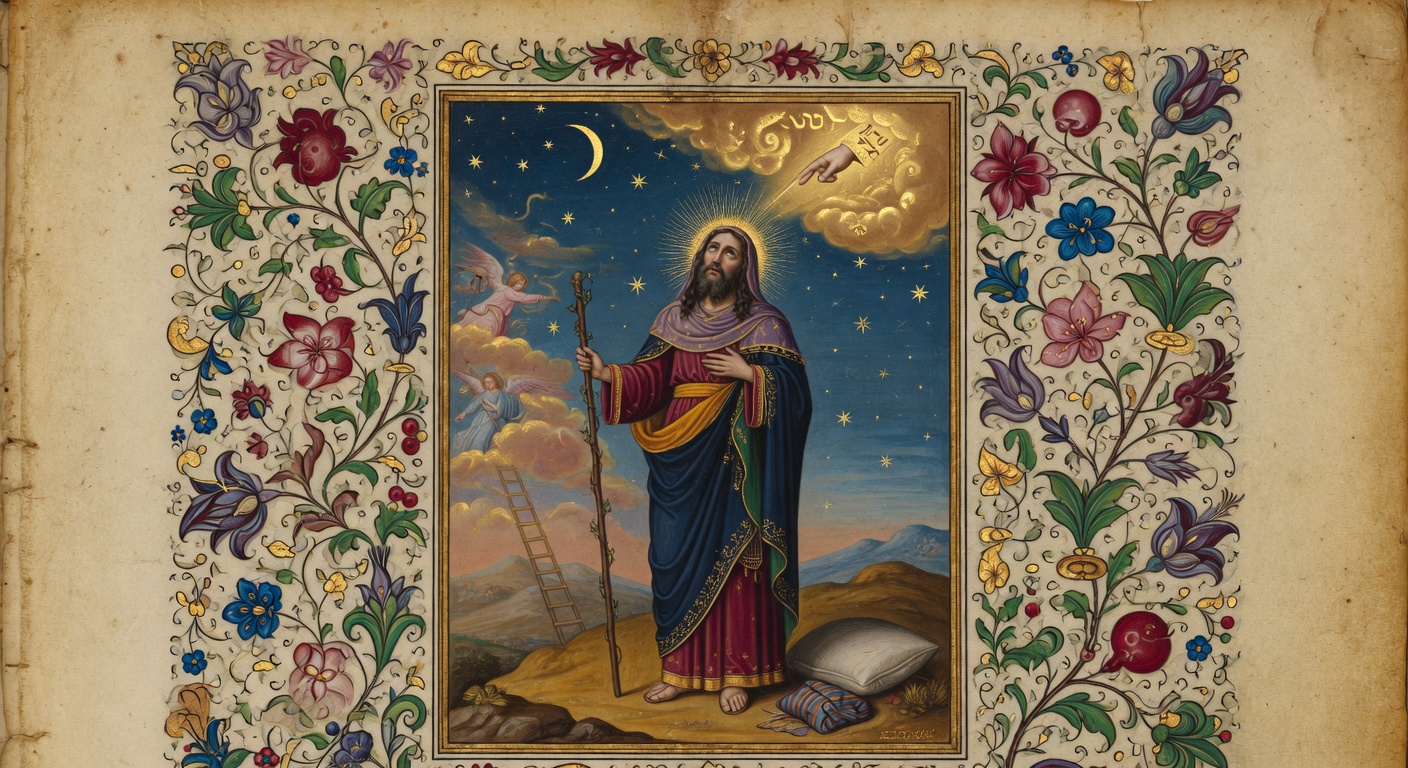
Jacob

Portrait of Jacob

Jacob, the son of Isaac and grandson of Abraham, played a pivotal role in the biblical narrative as one of the patriarchs of the faith. After deceiving his brother Esau to obtain the family blessing, Jacob fled to Haran where he married and fathered twelve sons. During a profound encounter with God, in which he wrestled with a divine being, Jacob was renamed Israel, signifying his transformation and the covenant promise. His twelve sons became the progenitors of the twelve tribes of Israel, establishing the foundation for the nation that would carry forward God's redemptive plan in Scripture.

0:00

Biography

Born
c. 2006 BC
Died
c. 1859 BC, Egypt
Age
147 years
Occupation
Patriarch, Herdsman
Father
Isaac
Mother
Rebekah
Spouse
Leah, Rachel, Bilhah, Zilpah
Children
Twelve sons and Dinah
Era
Patriarchs
Nationality
Hebrew
Also Known As
Israel

Family

Parents
โ†“
Jacob โšญ Leah Rachel Bilhah Zilpah
โ†“
Children
Twelve sons and Dinah
Old Testament Patriarchs Patriarch Genesis

Did You Know?

1

Jacob's name, meaning "supplanter" or "heel-grabber," directly references his grasping of Esau's heel during birth, a detail symbolizing his later displacement of his brother in acquiring the birthright and blessing within the ancient Israelite emphasis on divine election over primogeniture.

2

At the Jabbok ford, Jacob's nocturnal wrestling match resulted in both his renaming to Israel and a permanent limp, establishing the Israelite dietary taboo against eating the sciatic nerve as described in Genesis 32:32, a practice with roots in ancient Near Eastern ritual prohibitions.

3

Before returning to Bethel, Jacob ordered his household to bury their foreign gods and earrings beneath a terebinth tree near Shechem, an act reflecting a deliberate rejection of Canaanite cultic objects prior to covenant renewal in the patriarchal era.

4

Jacob adopted his grandsons Ephraim and Manasseh as full tribal heirs, granting the younger Ephraim the superior blessing and thereby inverting traditional inheritance norms to align with God's sovereign choice, as recorded in Genesis 48.

5

On his deathbed, Jacob rebuked Simeon and Levi for their violent attack on Shechem, citing their use of circumcision as a deceptive stratagem, which led to the dispersion of their tribes and highlighted the tensions between kinship loyalty and moral accountability in Genesis 49.

Key Passages

Jacob's Ladder

Genesis 28:10-22

God appears to the fleeing deceiver and freely extends the Abrahamic promises to him - demonstrating that divine election is based on grace, not merit.
A10nd Jacob went out from Beersheba, and went toward Haran.

11 And he lighted upon a certain place, and tarried there all night, because the sun was set; and he took of the stones of that place, and put them for his pillows, and lay down in that place to sleep. 12 And he dreamed, and behold a ladder set up on the earth, and the top of it reached to heaven: and behold the angels of God ascending and descending on it. 13 And, behold, the LORD stood above it, and said, I am the LORD God of Abraham thy father, and the God of Isaac: the land whereon thou liest, to thee will I give it, and to thy seed; 14 And thy seed shall be as the dust of the earth, and thou shalt spread abroad to the west, and to the east, and to the north, and to the south: and in thee and in thy seed shall all the families of the earth be blessed. 15 And, behold, I am with thee, and will keep thee in all places whither thou goest, and will bring thee again into this land; for I will not leave thee, until I have done that which I have spoken to thee of. 16 And Jacob awaked out of his sleep, and he said, Surely the LORD is in this place; and I knew it not. 17 And he was afraid, and said, How dreadful is this place! this is none other but the house of God, and this is the gate of heaven. 18 And Jacob rose up early in the morning, and took the stone that he had put for his pillows, and set it up for a pillar, and poured oil upon the top of it. 19 And he called the name of that place Bethel: but the name of that city was called Luz at the first. 20 And Jacob vowed a vow, saying, If God will be with me, and will keep me in this way that I go, and will give me bread to eat, and raiment to put on, 21 So that I come again to my fatherโ€™s house in peace; then shall the LORD be my God: 22 And this stone, which I have set for a pillar, shall be Godโ€™s house: and of all that thou shalt give me I will surely give the tenth unto thee.

Read full chapter: Genesis 28 โ†’

Wrestling with God

Genesis 32:22-32

Jacob's all-night struggle at Peniel transforms him from a schemer into a man marked by God. His new name Israel ('he struggles with God') defines the nation's identity.

A22nd he rose up that night, and took his two wives, and his two womenservants, and his eleven sons, and passed over the ford Jabbok.

23 And he took them, and sent them over the brook, and sent over that he had. 24 And Jacob was left alone; and there wrestled a man with him until the breaking of the day. 25 And when he saw that he prevailed not against him, he touched the hollow of his thigh; and the hollow of Jacobโ€™s thigh was out of joint, as he wrestled with him. 26 And he said, Let me go, for the day breaketh. And he said, I will not let thee go, except thou bless me. 27 And he said unto him, What is thy name? And he said, Jacob. 28 And he said, Thy name shall be called no more Jacob, but Israel: for as a prince hast thou power with God and with men, and hast prevailed. 29 And Jacob asked him, and said, Tell me, I pray thee, thy name. And he said, Wherefore is it that thou dost ask after my name? And he blessed him there. 30 And Jacob called the name of the place Peniel: for I have seen God face to face, and my life is preserved. 31 And as he passed over Penuel the sun rose upon him, and he halted upon his thigh. 32 Therefore the children of Israel eat not of the sinew which shrank, which is upon the hollow of the thigh, unto this day: because he touched the hollow of Jacobโ€™s thigh in the sinew that shrank.

Read full chapter: Genesis 32 โ†’

Renamed Israel

Genesis 35:9-15

The name change from Jacob ('supplanter') to Israel ('he strives with God') marks the completion of his transformation and establishes the name of God's covenant people.

A9nd God appeared unto Jacob again, when he came out of Padanaram, and blessed him.

10 And God said unto him, Thy name is Jacob: thy name shall not be called any more Jacob, but Israel shall be thy name: and he called his name Israel. 11 And God said unto him, I am God Almighty: be fruitful and multiply; a nation and a company of nations shall be of thee, and kings shall come out of thy loins; 12 And the land which I gave Abraham and Isaac, to thee I will give it, and to thy seed after thee will I give the land. 13 And God went up from him in the place where he talked with him. 14 And Jacob set up a pillar in the place where he talked with him, even a pillar of stone: and he poured a drink offering thereon, and he poured oil thereon. 15 And Jacob called the name of the place where God spake with him, Bethel.

Read full chapter: Genesis 35 โ†’