Hosea 11 KJV
God's Love for Israel
God's Love for Israel
The chapter depicts God using maternal imagery by describing how He 'taught Ephraim also to go, taking them by their arms' and healed them with 'cords of a man' and 'bands of love,' an unusually tender portrayal that contrasts with the dominant paternal metaphors elsewhere in the Hebrew Bible.
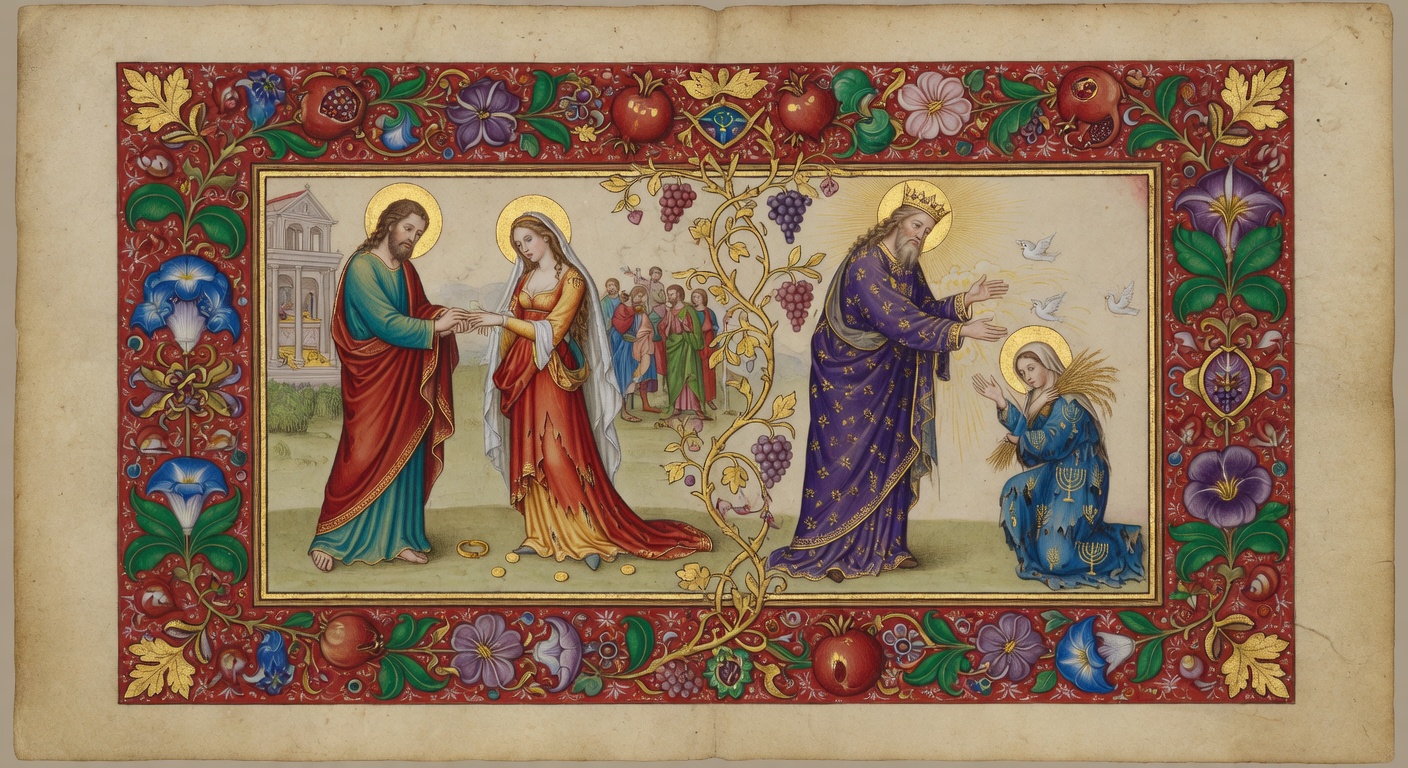
 1hen Israel was a child, then I loved him, and called my son out of Egypt.
2 As they called them, so they went from them: they sacrificed unto Baalim, and burned incense to graven images.
3 I taught Ephraim also to go, taking them by their arms; but they knew not that I healed them.
4 I drew them with cords of a man, with bands of love: and I was to them as they that take off the yoke on their jaws, and I laid meat unto them.
5 He shall not return into the land of Egypt, but the Assyrian shall be his king, because they refused to return.
6 And the sword shall abide on his cities, and shall consume his branches, and devour them, because of their own counsels.
7 And my people are bent to backsliding from me: though they called them to the most High, none at all would exalt him.
8 How shall I give thee up, Ephraim? how shall I deliver thee, Israel? how shall I make thee as Admah? how shall I set thee as Zeboim? mine heart is turned within me, my repentings are kindled together.
9 I will not execute the fierceness of mine anger, I will not return to destroy Ephraim: for I am God, and not man; the Holy One in the midst of thee: and I will not enter into the city.
10 They shall walk after the LORD: he shall roar like a lion: when he shall roar, then the children shall tremble from the west.
11 They shall tremble as a bird out of Egypt, and as a dove out of the land of Assyria: and I will place them in their houses, saith the LORD.
12 Ephraim compasseth me about with lies, and the house of Israel with deceit: but Judah yet ruleth with God, and is faithful with the saints.
← → arrow keys to navigate chapters · spacebar to play/pause audio
Did You Know?
The chapter depicts God using maternal imagery by describing how He 'taught Ephraim also to go, taking them by their arms' and healed them with 'cords of a man' and 'bands of love,' an unusually tender portrayal that contrasts with the dominant paternal metaphors elsewhere in the Hebrew Bible.
Verse 8's reference to Admah and Zeboim invokes the lesser-known cities destroyed alongside Sodom and Gomorrah in Deuteronomy 29:23, framing Israel's potential annihilation as a cosmic reversal of the Exodus while underscoring God's internal anguish over executing such judgment.
The prophecy creates a deliberate inversion of the Exodus narrative by threatening that Israel 'shall not return into the land of Egypt' yet will face Assyrian rule, only to pivot toward future restoration where God 'will roar like a lion' to summon trembling children from the west.
Hosea's use of the divine name in the first-person monologue ('How shall I give thee up, Ephraim?') exposes an anthropomorphic divine struggle between justice and mercy that is rare in prophetic texts, revealing God's decision to withhold full wrath as rooted in His own emotional restraint rather than Israel's merit.
The chapter links Israel's early apostasy at Baal-peor (implied through 'burning incense to graven images') with their later political alliances, portraying the nation's entire history from the Exodus onward as a single unbroken pattern of rejecting the very parental love that formed it as a people.
Hosea's three children received divinely mandated names. Jezreel, Lo-Ruhamah ('no compassion'), and Lo-Ammi ('not my people'). That functioned as public signs announcing the end of the northern dynasty and temporary revocation of Israel's covenant status.
This account illustrates Scripture’s emphasis on the extension of salvation beyond Jewish boundaries and Jesus’ willingness to cross social barriers to reveal truth.
The Nile River was worshipped as a god. Making the plague of blood a direct challenge to Egyptian religion.
Commentary & Study Notes Jamieson-Fausset-Brown (1871) · Public Domain Israel... called my son out of Egypt — BENGEL translates, "From the time that he (Israel) was in Egypt, I called him My son," which the parallelism proves. So Ho 12:9 and Ho 13:4 u…
Classic verse-by-verse commentary on Hosea 11 from Jamieson, Fausset & Brown (1871). Covers: God's former benefits, and Israel's ingratitude resulting in punishment, yet Jehovah promises restoration at last.
- 1
- Israel... called my son out of Egypt — BENGEL translates, "From the time that he (Israel) was in Egypt, I called him My son," which the parallelism proves. So Ho 12:9 and Ho 13:4 use "from... Egypt," for "from the time that thou didst sojourn in Egypt." Ex 4:22 also shows that Israel was called by God, "My son," from the time of his Egyptian sojourn (Isa 43:1). God is always said to have led or brought forth, not to have "called," Israel from Egypt. Mt 2:15, therefore, in quoting this prophecy (typically and primarily referring to Israel, antitypically and fully to Messiah), applies it to Jesus' sojourn in Egypt, not His return from it. Even from His infancy, partly spent in Egypt, God called Him His son. God included Messiah, and Israel for Messiah's sake, in one common love, and therefore in one common prophecy. Messiah's people and Himself are one, as the Head and the body. Isa 49:3 calls Him "Israel." The same general reason, danger of extinction, caused the infant Jesus, and Israel in its national infancy (compare Ge 42:1-43:34; 45:18; 46:3, 4; Eze 16:4-6; Jer 31:20) to sojourn in Egypt. So He, and His spiritual Israel, are already called "God's sons" while yet in the Egypt of the world.
- 2
- As they called them — "they," namely, monitors sent by Me. "Called," in Ho 11:1, suggests the idea of the many subsequent calls by the prophets. went from them — turned away in contempt (Jer 2:27). Baalim — images of Baal, set up in various places.
Read all 12 notes on Hosea 11 →