Proverbs 5 KJV
Warning Against Adultery
Warning Against Adultery
The chapter subverts Canaanite fertility symbolism by depicting the adulteress's lips as honeycomb and her mouth as smoother than oil, repurposing motifs of sacred prostitution to warn against idolatry disguised as sensuality.
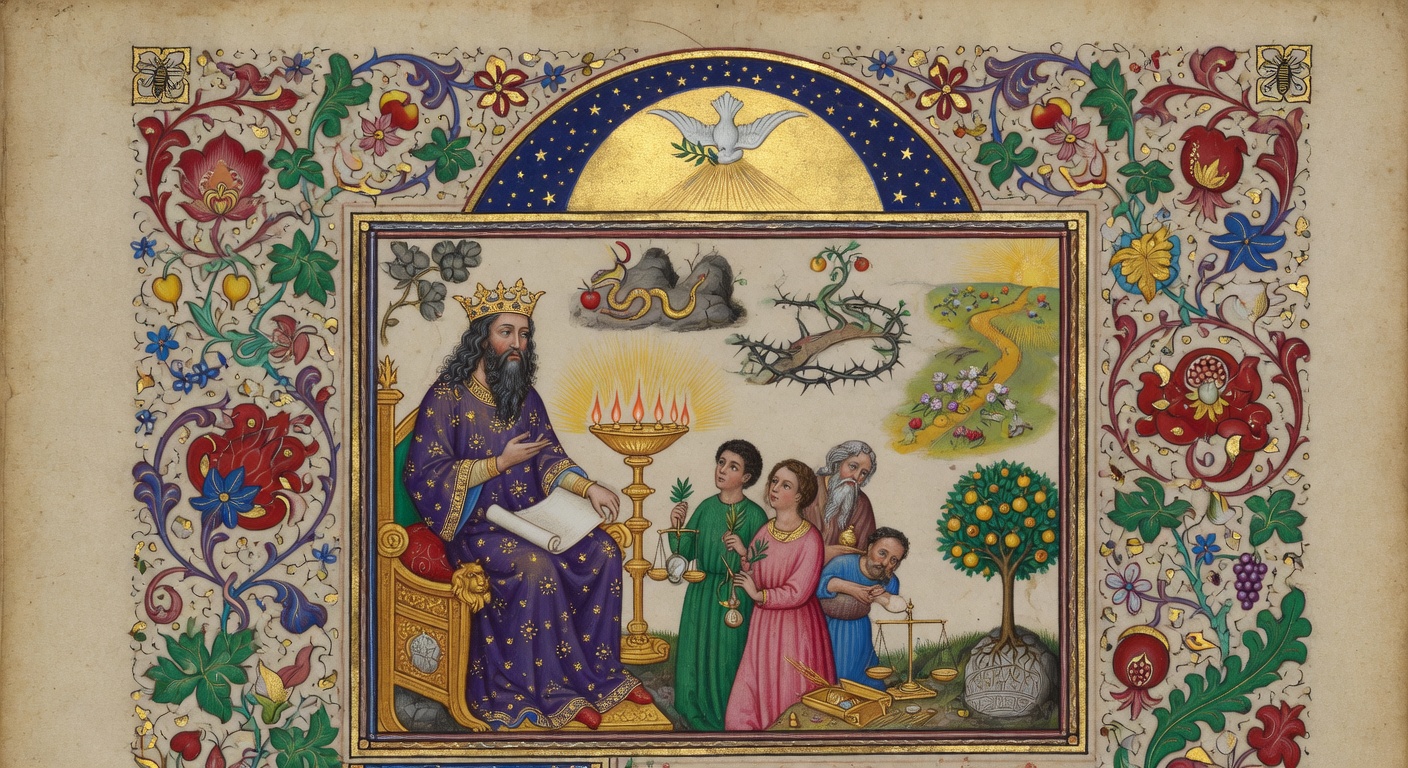
 1y son, attend unto my wisdom, and bow thine ear to my understanding:
2 That thou mayest regard discretion, and that thy lips may keep knowledge.
3 For the lips of a strange woman drop as an honeycomb, and her mouth is smoother than oil:
4 But her end is bitter as wormwood, sharp as a two-edged sword.
5 Her feet go down to death; her steps take hold on hell.
6 Lest thou shouldest ponder the path of life, her ways are moveable, that thou canst not know them.
7 Hear me now therefore, O ye children, and depart not from the words of my mouth.
8 Remove thy way far from her, and come not nigh the door of her house:
9 Lest thou give thine honour unto others, and thy years unto the cruel:
10 Lest strangers be filled with thy wealth; and thy labours be in the house of a stranger;
11 And thou mourn at the last, when thy flesh and thy body are consumed,
12 And say, How have I hated instruction, and my heart despised reproof;
13 And have not obeyed the voice of my teachers, nor inclined mine ear to them that instructed me!
14 I was almost in all evil in the midst of the congregation and assembly.
15 Drink waters out of thine own cistern, and running waters out of thine own well.
16 Let thy fountains be dispersed abroad, and rivers of waters in the streets.
17 Let them be only thine own, and not strangers’ with thee.
18 Let thy fountain be blessed: and rejoice with the wife of thy youth.
19 Let her be as the loving hind and pleasant roe; let her breasts satisfy thee at all times; and be thou ravished always with her love.
20 And why wilt thou, my son, be ravished with a strange woman, and embrace the bosom of a stranger?
21 For the ways of man are before the eyes of the LORD, and he pondereth all his goings.
22 His own iniquities shall take the wicked himself, and he shall be holden with the cords of his sins.
23 He shall die without instruction; and in the greatness of his folly he shall go astray.
← → arrow keys to navigate chapters · spacebar to play/pause audio
Did You Know?
The chapter subverts Canaanite fertility symbolism by depicting the adulteress's lips as honeycomb and her mouth as smoother than oil, repurposing motifs of sacred prostitution to warn against idolatry disguised as sensuality.
Verses 15-18 employ an extended cistern-and-well metaphor drawn from ancient Israelite property law, where private water sources represented inalienable inheritance, framing marital fidelity as both economic and covenantal stewardship.
The rare phrase 'rejoice with the wife of thy youth' echoes Deuteronomic covenant renewal language, portraying monogamous marriage as a living reenactment of Israel's exclusive bond with Yahweh rather than mere domestic advice.
Verse 14's reference to near-ruin 'in the midst of the congregation' alludes to ancient public shaming rituals at city gates, where adultery triggered communal economic and social sanctions beyond private guilt.
The father-son instructional frame mirrors the Egyptian Instruction of Amenemope yet redirects its foreign-woman warnings toward internal moral formation, highlighting Proverbs' adaptation of international wisdom for Yahwistic personal accountability.
Solomon conscripted 30,000 Israelite men for monthly rotations of forced labor in Lebanon to harvest cedar and cypress timber for the temple, while assigning an additional 150,000 Canaanite laborers to quarry and transport stone, reflecting the ancient Near Eastern practice of corvée labor systems.
While fleeing Saul, David sought refuge among the Philistines and feigned madness before King Achish of Gath by scribbling on the city gates and letting saliva run down his beard, successfully avoiding recognition.
Commentary & Study Notes Jamieson-Fausset-Brown (1871) · Public Domain This connection of wisdom and understanding is frequent (Pr 2:2; 3:7); the first denotes the use of wise means for wise ends; the other, the exercise of a proper discrimination in…
Classic verse-by-verse commentary on Proverbs 5 from Jamieson, Fausset & Brown (1871). Covers: A warning against the seductive arts of wicked women, enforced by considering the advantages of chastity, and the miserable end of the wicked.
- 1
- This connection of wisdom and understanding is frequent (Pr 2:2; 3:7); the first denotes the use of wise means for wise ends; the other, the exercise of a proper discrimination in their discovery.
- 2
- regard — or, "observe." keep — preserve constantly.
Read all 19 notes on Proverbs 5 →