Genesis 20 KJV
Abraham and Abimelech
Abraham and Abimelech
This chapter provides the Bible's first explicit use of the term 'prophet' for Abraham, when God instructs Abimelech that the patriarch alone can intercede effectively to lift the divine judgment on his household.
 1nd Abraham journeyed from thence toward the south country, and dwelled between Kadesh and Shur, and sojourned in Gerar.
2 And Abraham said of Sarah his wife, She is my sister: and Abimelech king of Gerar sent, and took Sarah.
3 But God came to Abimelech in a dream by night, and said to him, Behold, thou art but a dead man, for the woman which thou hast taken; for she is a man’s wife.
4 But Abimelech had not come near her: and he said, LORD, wilt thou slay also a righteous nation?
5 Said he not unto me, She is my sister? and she, even she herself said, He is my brother: in the integrity of my heart and innocency of my hands have I done this.
6 And God said unto him in a dream, Yea, I know that thou didst this in the integrity of thy heart; for I also withheld thee from sinning against me: therefore suffered I thee not to touch her.
7 Now therefore restore the man his wife; for he is a prophet, and he shall pray for thee, and thou shalt live: and if thou restore her not, know thou that thou shalt surely die, thou, and all that are thine.
8 Therefore Abimelech rose early in the morning, and called all his servants, and told all these things in their ears: and the men were sore afraid.
9 Then Abimelech called Abraham, and said unto him, What hast thou done unto us? and what have I offended thee, that thou hast brought on me and on my kingdom a great sin? thou hast done deeds unto me that ought not to be done.
10 And Abimelech said unto Abraham, What sawest thou, that thou hast done this thing?
11 And Abraham said, Because I thought, Surely the fear of God is not in this place; and they will slay me for my wife’s sake.
12 And yet indeed she is my sister; she is the daughter of my father, but not the daughter of my mother; and she became my wife.
13 And it came to pass, when God caused me to wander from my father’s house, that I said unto her, This is thy kindness which thou shalt shew unto me; at every place whither we shall come, say of me, He is my brother.
14 And Abimelech took sheep, and oxen, and menservants, and womenservants, and gave them unto Abraham, and restored him Sarah his wife.
15 And Abimelech said, Behold, my land is before thee: dwell where it pleaseth thee.
16 And unto Sarah he said, Behold, I have given thy brother a thousand pieces of silver: behold, he is to thee a covering of the eyes, unto all that are with thee, and with all other: thus she was reproved.
17 So Abraham prayed unto God: and God healed Abimelech, and his wife, and his maidservants; and they bare children.
18 For the LORD had fast closed up all the wombs of the house of Abimelech, because of Sarah Abraham’s wife.
← → arrow keys to navigate chapters · spacebar to play/pause audio
Did You Know?
This chapter provides the Bible's first explicit use of the term 'prophet' for Abraham, when God instructs Abimelech that the patriarch alone can intercede effectively to lift the divine judgment on his household.
Abraham's defense that Sarah is his half-sister (sharing a father but not a mother) introduces a detail absent from the parallel Egypt episode in Genesis 12, complicating the ethics of the deception within ancient Near Eastern kinship structures.
The closing of every womb in Abimelech's house functions as a targeted reversal of fertility, prefiguring the barrenness motifs that dominate the subsequent Isaac and Jacob cycles and requiring Abraham's prophetic prayer for restoration.
Abimelech's generous gifts of sheep, oxen, and a thousand pieces of silver function less as bride-price than as a 'covering of the eyes,' a rare idiomatic phrase that may allude to both compensation for public shame and the symbolic veiling of Sarah's status.
The episode deliberately mirrors and inverts the Pharaoh story of Genesis 12 while anticipating Isaac's near-identical encounter with an Abimelech in Genesis 26, forming a deliberate triadic pattern that underscores the patriarchs' persistent distrust of divine protection.
Though the Bible calls Abimelech king of the Philistines, this is likely an anachronistic or titular reference, as the name Abimelech functioned as a recurring dynastic title for rulers of Gerar rather than denoting a single individual across the patriarchal narratives.
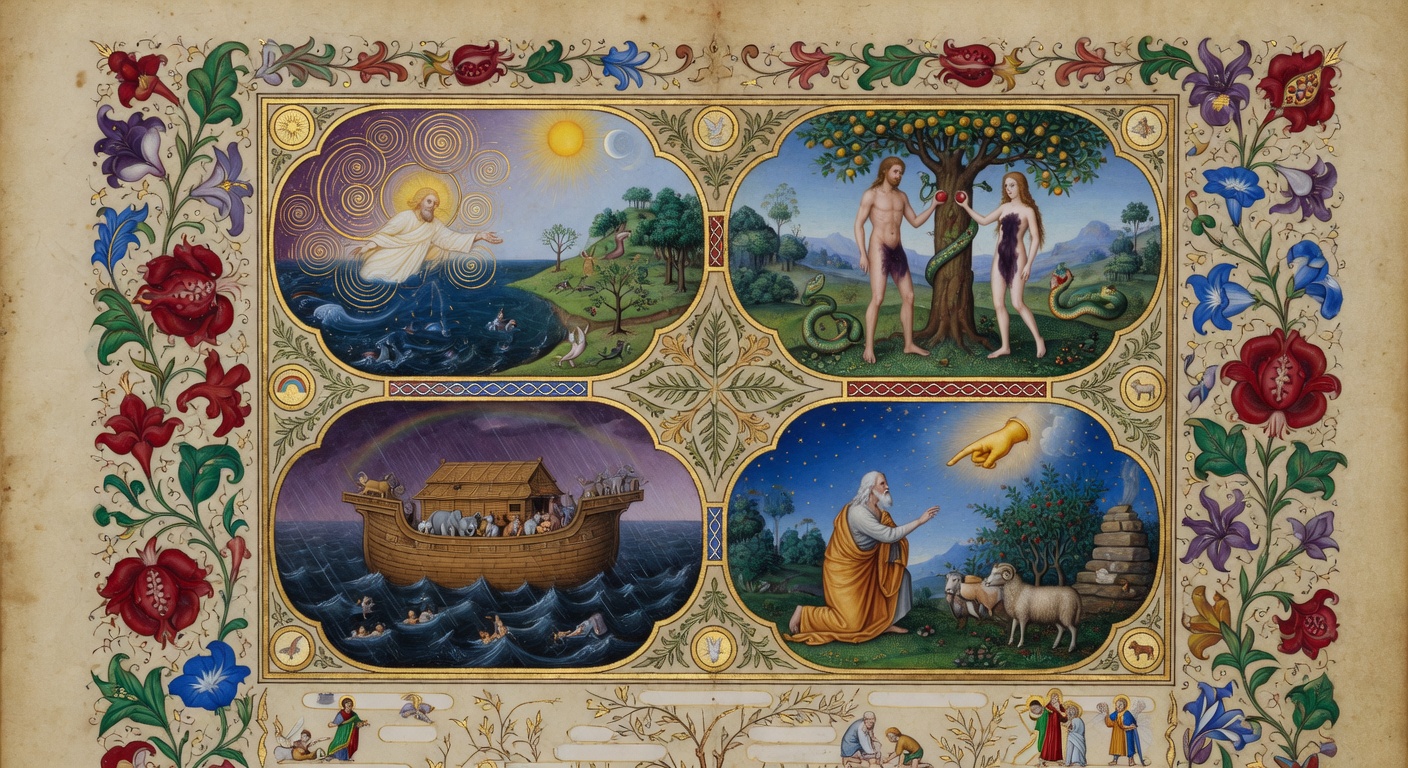
Adam's name derives from the Hebrew 'adamah' (ground), linking his creation directly to the earth's dust in a wordplay that underscores ancient Israelite views of humanity's mortal origins and agricultural ties, unlike divine births in neighboring myths.
The name Eve, or Chavah in Hebrew, means "life-giver" or "mother of all living" and was given by Adam only after the Fall, underscoring her future role despite the curse of death.
Noah lived 950 years total, spending the final 350 years after the flood as a farmer who became Scripture's first recorded vintner by planting a vineyard.
Isaac later settled in the same area, repeating the deception with Rebekah amid conflicts over wells, before renewing the treaty with the Philistine king.
The Hebrew word 'Eden' means 'delight' or 'pleasure'.
The Great Ziggurat of Ur still stands today in modern Iraq.
Commentary & Study Notes Jamieson-Fausset-Brown (1871) · Public Domain Abraham journeyed from thence... and dwelled between Kadesh and Shur — Leaving the encampment, he migrated to the southern border of Canaan. In the neighborhood of Gerar was a very…
Classic verse-by-verse commentary on Genesis 20 from Jamieson, Fausset & Brown (1871). Covers: Abraham's denial of his wife.
- 1
- Abraham journeyed from thence... and dwelled between Kadesh and Shur — Leaving the encampment, he migrated to the southern border of Canaan. In the neighborhood of Gerar was a very rich and well-watered pasture land.
- 2
- Abraham said of Sarah his wife, She is my sister — Fear of the people among whom he was, tempted him to equivocate. His conduct was highly culpable. It was deceit, deliberate and premeditated — there was no sudden pressure upon him — it was the second offense of the kind [see on Ge 12:13] — it was a distrust of God every way surprising, and it was calculated to produce injurious effects on the heathen around. Its mischievous tendency was not long in being developed. Abimelech (father-king)... sent and took Sarah — to be one of his wives, in the exercise of a privilege claimed by Eastern sovereigns, already explained (see on Ge 12:15).
Read all 6 notes on Genesis 20 →