Genesis 48 KJV
Jacob Blesses Ephraim and Manasseh
Jacob Blesses Ephraim and Manasseh
Jacob's adoption of Ephraim and Manasseh grants Joseph the double inheritance portion normally due the firstborn, effectively disinheriting Reuben in line with the recurring Genesis motif of divine reversal of primogeniture.
 1nd it came to pass after these things, that one told Joseph, Behold, thy father is sick: and he took with him his two sons, Manasseh and Ephraim.
2 And one told Jacob, and said, Behold, thy son Joseph cometh unto thee: and Israel strengthened himself, and sat upon the bed.
3 And Jacob said unto Joseph, God Almighty appeared unto me at Luz in the land of Canaan, and blessed me,
4 And said unto me, Behold, I will make thee fruitful, and multiply thee, and I will make of thee a multitude of people; and will give this land to thy seed after thee for an everlasting possession.
5 And now thy two sons, Ephraim and Manasseh, which were born unto thee in the land of Egypt before I came unto thee into Egypt, are mine; as Reuben and Simeon, they shall be mine.
6 And thy issue, which thou begettest after them, shall be thine, and shall be called after the name of their brethren in their inheritance.
7 And as for me, when I came from Padan, Rachel died by me in the land of Canaan in the way, when yet there was but a little way to come unto Ephrath: and I buried her there in the way of Ephrath; the same is Bethlehem.
8 And Israel beheld Joseph’s sons, and said, Who are these?
9 And Joseph said unto his father, They are my sons, whom God hath given me in this place. And he said, Bring them, I pray thee, unto me, and I will bless them.
10 Now the eyes of Israel were dim for age, so that he could not see. And he brought them near unto him; and he kissed them, and embraced them.
11 And Israel said unto Joseph, I had not thought to see thy face: and, lo, God hath shewed me also thy seed.
12 And Joseph brought them out from between his knees, and he bowed himself with his face to the earth.
13 And Joseph took them both, Ephraim in his right hand toward Israel’s left hand, and Manasseh in his left hand toward Israel’s right hand, and brought them near unto him.
14 And Israel stretched out his right hand, and laid it upon Ephraim’s head, who was the younger, and his left hand upon Manasseh’s head, guiding his hands wittingly; for Manasseh was the firstborn.
15 And he blessed Joseph, and said, God, before whom my fathers Abraham and Isaac did walk, the God which fed me all my life long unto this day,
16 The Angel which redeemed me from all evil, bless the lads; and let my name be named on them, and the name of my fathers Abraham and Isaac; and let them grow into a multitude in the midst of the earth.
17 And when Joseph saw that his father laid his right hand upon the head of Ephraim, it displeased him: and he held up his father’s hand, to remove it from Ephraim’s head unto Manasseh’s head.
18 And Joseph said unto his father, Not so, my father: for this is the firstborn; put thy right hand upon his head.
19 And his father refused, and said, I know it, my son, I know it: he also shall become a people, and he also shall be great: but truly his younger brother shall be greater than he, and his seed shall become a multitude of nations.
20 And he blessed them that day, saying, In thee shall Israel bless, saying, God make thee as Ephraim and as Manasseh: and he set Ephraim before Manasseh.
21 And Israel said unto Joseph, Behold, I die: but God shall be with you, and bring you again unto the land of your fathers.
22 Moreover I have given to thee one portion above thy brethren, which I took out of the hand of the Amorite with my sword and with my bow.
← → arrow keys to navigate chapters · spacebar to play/pause audio
Did You Know?
Jacob's adoption of Ephraim and Manasseh grants Joseph the double inheritance portion normally due the firstborn, effectively disinheriting Reuben in line with the recurring Genesis motif of divine reversal of primogeniture.
The deliberate crossing of Jacob's hands to favor the younger Ephraim over Manasseh enacts a theological principle seen elsewhere in the book, where God's choice repeatedly subverts cultural expectations of birth order.
Jacob's invocation of 'the Angel which redeemed me from all evil' (v. 16) stands out as one of the few patriarchal references to a personal redemptive mediator, suggesting an early trace of angelomorphic or Christophanic tradition.
The sudden recollection of Rachel's death and burial near Ephrath (Bethlehem) in v. 7 interrupts the blessing narrative, linking Joseph's sons to Jacob's unresolved grief and foreshadowing Bethlehem's later messianic associations.
By naming Ephraim and Manasseh as full heirs alongside his own sons, Jacob creates the tribal division of Joseph into two separate allotments, a structural anomaly that later enables the northern kingdom's distinct identity apart from Judah.
Biblical authors frequently employed "Ephraim" as a synecdoche for the entire northern kingdom of Israel in prophetic oracles, underscoring how one tribe's political and cultic influence overshadowed the other nine northern tribes combined.
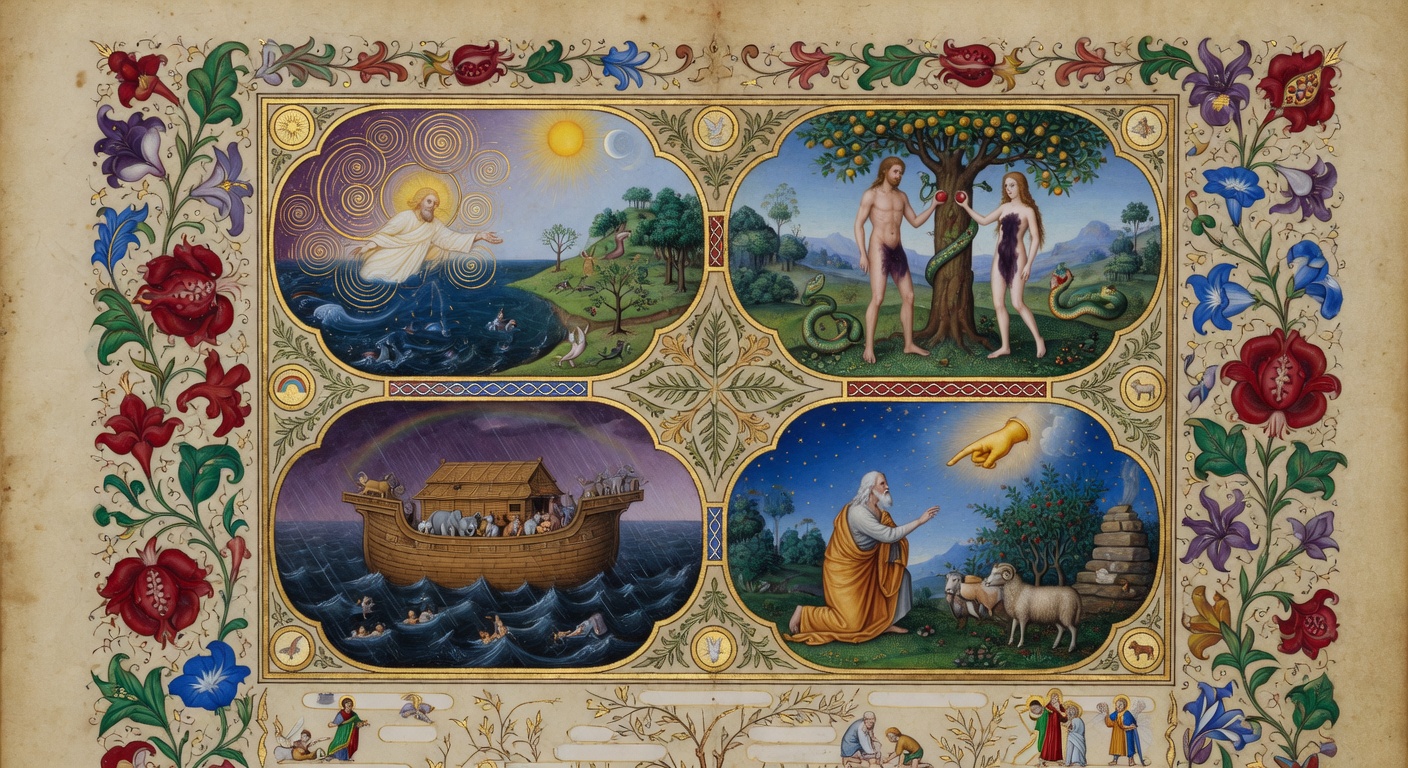
Genesis records Adam's lifespan as 930 years yet omits any account of his death or burial, contrasting with later patriarchs and leaving his end as a textual gap that early Jewish interpreters filled with traditions like burial at Hebron.
Although God gave the original prohibition against eating from the Tree of Knowledge solely to Adam before Eve's creation, Eve later tells the serpent they must not even touch the fruit, indicating she may have received an expanded version through Adam.
Post-flood, Noah's nakedness and resulting curse on Canaan (Genesis 9:20-27) forms the biblical etiology for later Canaanite-Israelite conflicts rather than a blanket curse on all Ham's descendants.
The exact location of Eden remains one of the greatest unsolved mysteries in biblical geography.
Archaeological excavations revealed Ur had flush toilets and a sophisticated sewage system by 2000 BC.
Mount Ararat is the tallest peak in modern Turkey at 16,854 feet.
Commentary & Study Notes Jamieson-Fausset-Brown (1871) · Public Domain one told Joseph, Behold, thy father is sick — Joseph was hastily sent for, and on this occasion he took with him his two sons.
Classic verse-by-verse commentary on Genesis 48 from Jamieson, Fausset & Brown (1871). Covers: Joseph's visit to his sick father.
- 1
- one told Joseph, Behold, thy father is sick — Joseph was hastily sent for, and on this occasion he took with him his two sons.
- 2
- Israel strengthened himself, and sat upon the bed — In the chamber where a good man lies, edifying and spiritual discourse may be expected.
Read all 9 notes on Genesis 48 →